
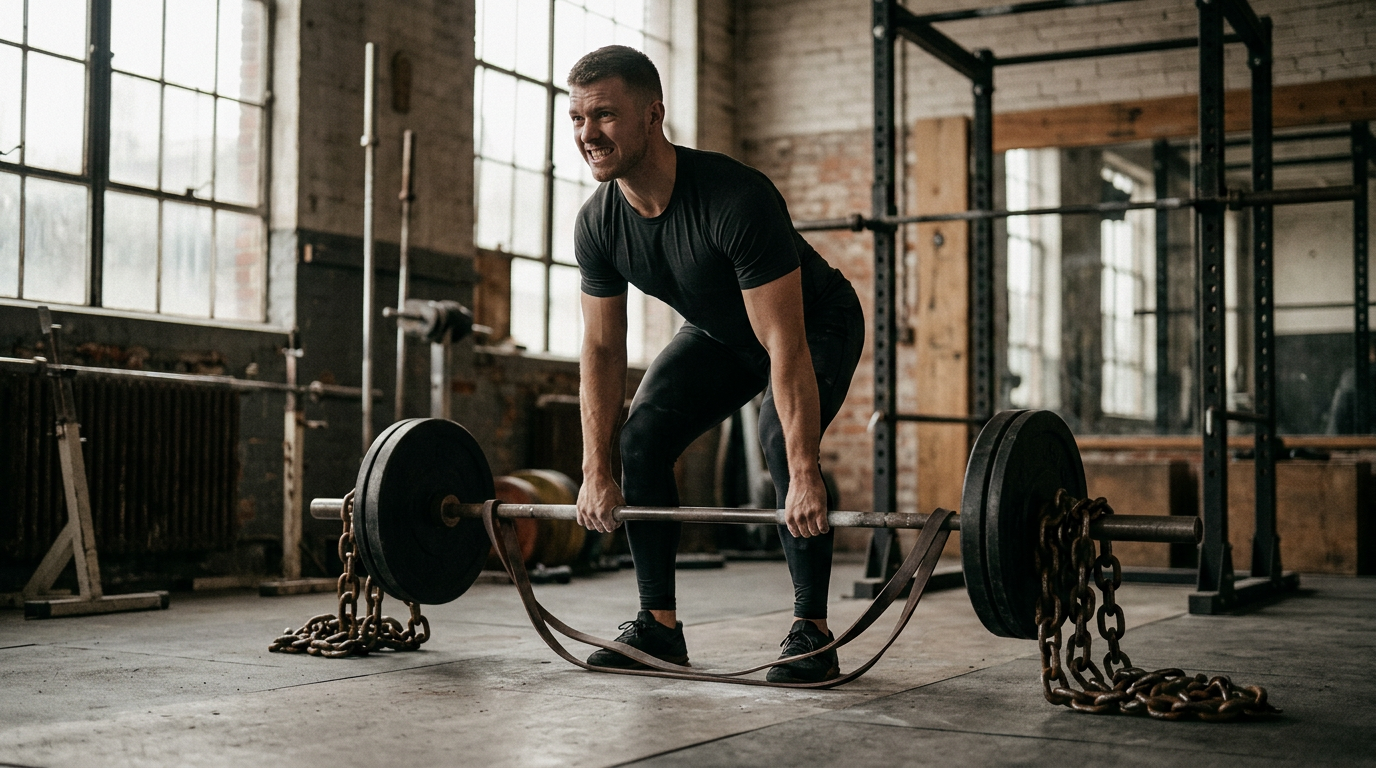
What's the Best Way to Use Accommodating Resistance?
Accommodating resistance using bands and chains creates variable tension that matches your natural strength curve, with resistance increasing as you move through the strongest portions of a lift. This method helps develop explosive power, overcome sticking points, and build strength in ranges where traditional weights provide insufficient challenge.
Unlike static weights that remain constant throughout a movement, accommodating resistance adapts to your biomechanical advantages and disadvantages at different joint angles.
Understanding Your Natural Strength Curve
Every lift has a strength curve—portions where you're mechanically stronger or weaker based on joint angles and muscle length-tension relationships.
Take the squat: you're weakest at the bottom (poor leverage, stretched position) and strongest at the top (better leverage, optimal muscle length). Traditional barbells provide the same resistance throughout, meaning the bottom position limits how much weight you can use for the entire movement.
Accommodating resistance solves this mismatch by providing:
- Minimal resistance at mechanically weak positions
- Maximum resistance at mechanically strong positions
- Progressive loading that matches your strength curve
How Bands Transform Your Training
Resistance bands create linear variable resistance—tension increases proportionally with stretch. As you move through a lift's range of motion, the bands stretch further, adding more resistance.
Band Training Benefits
Explosive Power Development: Bands force you to accelerate through the entire range of motion. Unlike regular weights that you can slow down at the top, bands pull back harder as they stretch.
Accommodating Resistance Patterns: Bands naturally match most lifting patterns. In a squat, bands provide minimal resistance at the bottom (where you're weakest) and maximum resistance at lockout (where you're strongest).
Sticking Point Elimination: By overloading the top portion of lifts, bands help you develop strength in ranges that typically aren't challenged with straight weight.
Effective Band Setups
Squat and Deadlift: Loop bands around the barbell and anchor points at floor level. Start with 20-30% of your 1RM in band tension at the top.
Bench Press: Attach bands to the bottom of a power rack or heavy dumbbells. The bands should have slight tension at chest level and significant tension at lockout.
Speed Work: Use 50-60% bar weight plus 20-25% band tension for dynamic effort training.
When tracking band work in Kenso, note both the bar weight and estimated band tension at the top of each movement for accurate progression tracking.
Chain Training: A Different Approach
Chains provide accommodating resistance through weight distribution rather than elastic tension. As you lift, more chain links leave the floor, progressively adding weight.
Chain Training Advantages
Natural Deceleration: Unlike bands that pull you back down, chains simply reduce resistance as they return to the floor. This allows for more natural movement patterns.
Precise Loading: Chains offer predictable resistance increases. A 40-pound chain adds roughly 20 pounds of resistance from bottom to top (half the chain weight).
Stability Challenge: Chains create slight instability that engages stabilizing muscles without compromising movement quality.
Chain Setup Guidelines
Proper Chain Selection: Use 5/8" or 3/4" chains for most applications. Smaller chains don't provide enough resistance; larger chains are unwieldy.
Optimal Height: Set chains so 2-3 links remain on the floor at the bottom position. This prevents the chain from going slack while ensuring progressive loading.
Weight Distribution: Total chain weight should represent 10-20% of your 1RM for strength work, up to 25% for speed training.
Programming Accommodating Resistance
Strength Development Phase
Week 1-2: 80% bar weight + 10% accommodating resistance
Week 3-4: 75% bar weight + 15% accommodating resistance
Week 5-6: 70% bar weight + 20% accommodating resistance
This progression maintains similar total load while shifting more resistance to stronger ranges of motion.
Speed and Power Phase
Dynamic Effort: 50-60% bar weight + 20-25% accommodating resistance Rep Range: 3-5 reps focusing on maximum acceleration Rest Periods: 45-60 seconds between sets
Accessory Integration
Use lighter accommodating resistance (10-15%) with accessory movements to:
- Improve lockout strength in pressing movements
- Develop hip drive in squatting patterns
- Enhance finishing power in pulling movements
Common Mistakes to Avoid
Too Much Too Soon: Start with minimal accommodating resistance (10-15%) and progress gradually. Your nervous system needs time to adapt to variable loading patterns.
Ignoring Bar Speed: Accommodating resistance training requires intent to move fast. Slow, grinding reps defeat the purpose.
Poor Setup: Incorrect band or chain positioning can create uneven loading or compromise movement patterns. Take time to dial in your setup.
Tracking Inconsistencies: Variable resistance makes tracking complex. In Kenso, record both static weight and estimated accommodating resistance for accurate progression monitoring.
Measuring Progress with Variable Resistance
Tracking accommodating resistance requires different metrics than traditional lifting:
Bar Speed: Use a velocity-based training device or simply focus on consistent acceleration through each rep.
Total System Load: Calculate the combination of bar weight plus peak accommodating resistance.
Range-Specific Strength: Test lockout strength separately from full-range strength to assess improvements in different portions of the lift.
Kenso's flexible tracking system allows you to record these complex loading schemes, helping you identify which accommodating resistance methods work best for your training.
Equipment Recommendations
For lifters serious about accommodating resistance training, quality equipment makes a significant difference.
POWER GUIDANCE Pull Up Assist Bands offer five resistance levels perfect for accommodating resistance work. The variety lets you fine-tune loading for different lifts and strength levels.
When selecting chains, invest in quality 5/8" chains with proper collars. Cheap chains break under load and create safety hazards.
The Bottom Line
Accommodating resistance transforms traditional lifts by matching resistance to your strength curve. Whether using bands for explosive power development or chains for natural loading progression, these methods help you train with greater intention and specificity.
Start conservatively, focus on movement quality, and track your progress systematically. The key isn't just using bands and chains—it's understanding how they complement your existing program and long-term progression goals.
Ready to integrate accommodating resistance into your training? Download Kenso to track complex loading schemes and monitor your progress with variable resistance training.
What percentage of accommodating resistance should beginners start with?
Beginners should start with 10-15% of their 1RM in accommodating resistance combined with 75-80% bar weight. This allows adaptation to variable loading without overwhelming the nervous system.
Can you use bands and chains together in the same workout?
Yes, but avoid using them on the same exercise within a session. You can use bands for one movement (like bench press) and chains for another (like squats) in the same workout for variety.
How often should you train with accommodating resistance?
Limit accommodating resistance to 1-2 sessions per week per movement pattern. Your nervous system needs recovery time from the high demands of variable resistance training.
Do bands and chains work better for certain lifts?
Bands work exceptionally well for bench press and squats due to their strength curves. Chains are particularly effective for deadlifts and can add stability challenges to any lift.
Should you deload when using accommodating resistance?
Yes, deload weeks should reduce both bar weight and accommodating resistance by 40-50%. The high neural demand of variable resistance makes recovery periods essential.
This article contains affiliate links. We may earn a small commission at no extra cost to you.