
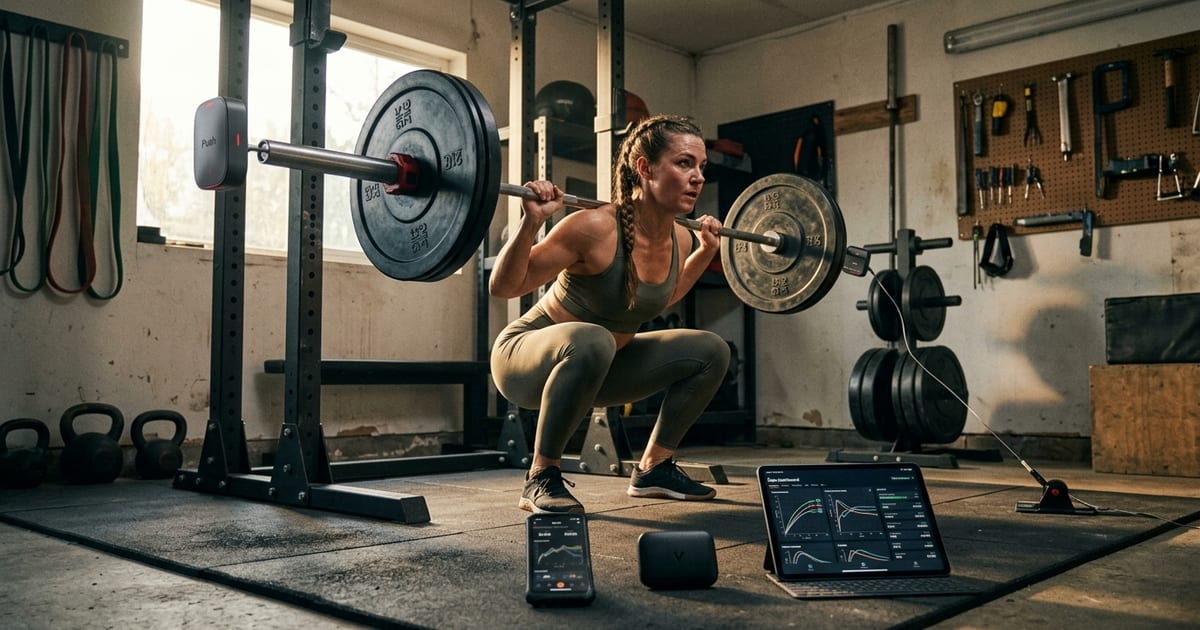
The PUSH Band 2.0 is the best VBT device for most home athletes in 2026, offering wireless convenience and solid accuracy at $399. For lifters prioritizing maximum precision, the GymAware RS delivers laboratory-grade measurements at $2,200, while the MyLift Linear Position Transducer provides an excellent entry point at $199 for those new to velocity based training.
TL;DR: VBT Device Recommendations for 2026
For home athletes serious about velocity based training, the PUSH Band 2.0 strikes the best balance of accuracy, convenience, and price at $399. Its wireless design eliminates setup hassles while delivering ±3% accuracy across all major lifts. The GymAware RS remains the gold standard for precision at $2,200, using linear position transducer technology for ±1% accuracy. Budget-conscious lifters should consider the MyLift LPT at $199, which offers solid performance for basic bar velocity measurement. Whichever device you choose, the velocity data is only useful when it informs structured training — read the velocity feedback during your session, then log your actual sets, reps, and loads in a dedicated training app like Kenso so your progression stays in one place.
Best VBT Devices for Home Athletes (Ranked)
1. PUSH Band 2.0
Best overall for home athletes seeking wireless convenience and reliable accuracy.
- Wireless accelerometer technology with ±3% accuracy
- 12-hour battery life with magnetic charging
- Works with all barbell movements and bodyweight exercises
- Real-time feedback via smartphone app
- Price: $399
2. GymAware RS (PowerTool)
Most accurate option for serious lifters willing to invest in professional-grade equipment.
- Linear position transducer with ±1% accuracy
- Wired connection ensures zero data loss
- Advanced metrics including force, power, and velocity curves
- Requires ceiling mounting or rack attachment
- Price: $2,200
3. MyLift Linear Position Transducer
Best budget entry point for lifters new to velocity based training.
- String-based linear encoder with ±5% accuracy
- Smartphone app with basic velocity tracking
- Portable design with magnetic base attachment
- Limited to vertical movements only
- Price: $199
4. Vitruve Linear Velocity Transducer
Solid mid-range option with good accuracy and team features.
- Linear encoder technology with ±2% accuracy
- Cloud-based data storage and analysis
- Team management features for coaches
- Requires physical attachment to barbell
- Price: $595
5. Beast Sensor 2.0
Wearable option for athletes training multiple movement patterns.
- IMU-based sensor with ±4% accuracy
- Wearable design works for dumbbells and kettlebells
- Limited battery life (6 hours)
- Less accurate for pure strength movements
- Price: $299
6. Tendo Weightlifting Analyzer
Established brand with reliable performance but outdated interface.
- Cable-based linear transducer with ±2% accuracy
- Proven track record in research settings
- Outdated software interface
- Requires laptop connection
- Price: $1,800
7. RepOne Strength Sensor
Newer entry with promising technology but limited track record.
- Computer vision-based tracking via smartphone camera
- No additional hardware required
- Accuracy varies with lighting conditions (±6-10%)
- Still in beta testing phase
- Price: $29/month subscription
VBT Device Comparison Table
| Device | Technology | Accuracy | Setup Time | Battery Life | Price |
|---|---|---|---|---|---|
| PUSH Band 2.0 | Accelerometer | ±3% | 30 seconds | 12 hours | $399 |
| GymAware RS | Linear Position | ±1% | 5 minutes | Wired | $2,200 |
| MyLift LPT | String Encoder | ±5% | 2 minutes | 8 hours | $199 |
| Vitruve LVT | Linear Encoder | ±2% | 3 minutes | 10 hours | $595 |
| Beast Sensor 2.0 | IMU | ±4% | 1 minute | 6 hours | $299 |
| Tendo Analyzer | Cable LPT | ±2% | 10 minutes | Wired | $1,800 |
| RepOne Sensor | Computer Vision | ±6-10% | 1 minute | N/A | $29/month |
How to Choose the Right VBT Device
Consider your accuracy requirements. If you're using VBT for autoregulation and need precise load adjustments, invest in a linear position transducer like the GymAware RS. For general velocity tracking and motivation, accelerometer-based devices like the PUSH Band 2.0 provide sufficient accuracy.
Evaluate your setup constraints. Home gym athletes benefit from wireless devices that don't require permanent installation. The PUSH Band 2.0 and Beast Sensor 2.0 offer maximum flexibility, while string-based systems need attachment points above your lifting area.
Factor in your movement variety. Powerlifters focusing on the big three lifts can use any linear position transducer effectively. Athletes training with dumbbells, kettlebells, or bodyweight movements need accelerometer-based systems or wearable sensors.
Budget for the complete system. Beyond the device cost, consider subscription fees, mounting hardware, and potential software upgrades. Some devices require ongoing monthly fees for cloud storage and advanced analytics.
Plan how you'll keep the data. Most VBT devices offer CSV export or API access so you can archive velocity data alongside your training logs. If your logging app doesn't import velocity data, keep the two tools separate — record velocity in the device's own app, and log your sets, reps, and loads in your dedicated training app.
Understanding VBT Technology Types
Linear Position Transducers (LPTs)
Linear position transducers measure bar displacement over time to calculate velocity. These devices use either string encoders or optical sensors to track barbell movement with high precision. The GymAware RS and Vitruve systems represent this technology category.
LPTs offer superior accuracy (±1-2%) but require physical attachment to the barbell and often need mounting above the lifting area. They excel at measuring pure vertical movements like squats, deadlifts, and bench press.
Accelerometer-Based Systems
Accelerometer systems like the PUSH Band 2.0 measure acceleration forces and calculate velocity through integration algorithms. These wireless devices attach directly to the barbell or athlete's body.
While slightly less accurate (±3-4%) than LPTs, accelerometers offer unmatched convenience and work across all movement patterns. They're ideal for home athletes who value setup simplicity over maximum precision.
Computer Vision Systems
Emerging computer vision technology uses smartphone cameras to track bar movement. RepOne pioneered this approach, offering VBT functionality without additional hardware.
Accuracy depends heavily on lighting conditions and camera positioning, making these systems less reliable than dedicated hardware. However, the low cost and zero setup time make them attractive for beginners.
VBT Integration with Training Programs
Velocity based training works best when integrated with structured programming rather than used as a standalone tool. Use velocity targets to inform your load selection each session — pick the weight that lets you hit your prescribed bar speed for the day — then log the actual sets you complete in your training app so the broader progression stays intact.
Successful VBT implementation requires establishing baseline velocities for different percentage loads. Most athletes see significant velocity drops (20-30%) when fatigue accumulates, making VBT an excellent autoregulation tool.
The key is consistency in measurement conditions. Use the same device, attachment point, and measurement protocol for each session to ensure reliable data. Even small changes in sensor placement can affect velocity readings by 5-10%.
Budget Considerations for Home Athletes
VBT devices represent a significant investment, especially for home gym setups. The MyLift LPT at $199 provides an excellent entry point for lifters curious about velocity tracking. Its ±5% accuracy suffices for basic autoregulation and progress monitoring.
Mid-range options like the PUSH Band 2.0 ($399) offer the best value proposition. The wireless convenience and ±3% accuracy justify the price premium for most serious lifters. The device pays for itself through improved training efficiency and reduced injury risk.
Professional-grade systems like the GymAware RS ($2,200) make sense for competitive athletes or coaches training multiple lifters. The laboratory-grade accuracy enables precise load prescriptions and detailed biomechanical analysis.
What's the most accurate VBT device for home use?
The GymAware RS offers the highest accuracy at ±1% using linear position transducer technology. However, the PUSH Band 2.0 provides excellent accuracy (±3%) with much greater convenience for most home athletes.
Can I use VBT devices with any barbell?
Most VBT devices work with standard Olympic barbells. Linear position transducers require attachment points, while accelerometer-based systems like the PUSH Band can attach directly to any barbell sleeve.
How much does velocity drop when fatigue sets in?
Typical velocity drops range from 10-30% as fatigue accumulates during a training session. A 20% velocity drop often indicates significant fatigue and suggests ending the set or reducing load.
Do VBT devices work for all exercises?
Linear position transducers work best for vertical movements (squats, deadlifts, bench press). Accelerometer-based devices like the PUSH Band work across all movement patterns, including rows, curls, and Olympic lifts.
Is the subscription cost worth it for VBT apps?
Many VBT devices include basic apps for free, with premium features requiring subscriptions ($10-30/month). The value depends on whether you need advanced analytics, cloud storage, or team management features.
How do I set up velocity targets for different lifts?
Establish baseline velocities at various percentages (60%, 70%, 80%, 90% 1RM) for each lift. Use these baselines to set velocity targets that correspond to your desired training intensity for each session.
Can I integrate VBT data with other training apps?
Most modern VBT devices offer data export via CSV files or API integration. Keep in mind that velocity data lives in the device's own ecosystem — if your training logger doesn't accept velocity imports, treat the two as complementary tools: read velocity in the moment, and record your completed sets and loads in your training app.
What's the learning curve for VBT technology?
Basic velocity tracking requires minimal learning, but effective autoregulation takes 4-6 weeks to establish reliable baselines. Start with simple velocity targets before implementing complex fatigue thresholds.
Velocity feedback tells you how fast the bar is moving on a given day; a disciplined training log tells you how that translates into long-term progress. Pair a quality VBT device with detailed set-by-set logging in the Kenso app, and you get the best of both — in-the-moment intensity cues plus the consistent progression tracking that actually drives results over months of training.
This article contains affiliate links. We may earn a small commission at no extra cost to you.