
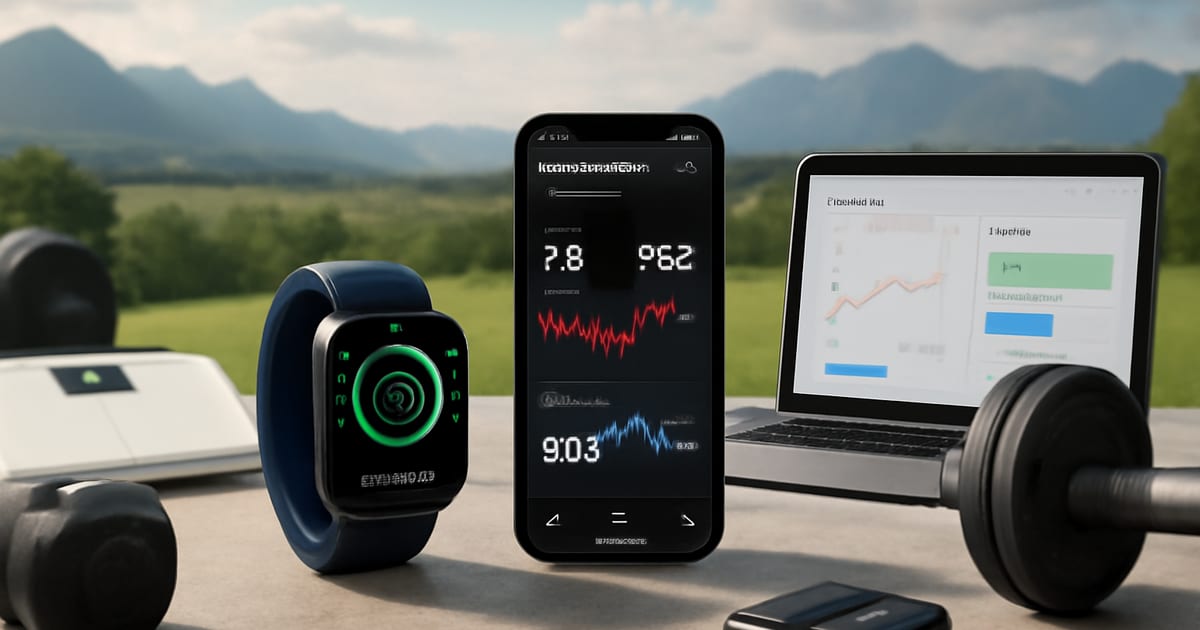
Would Apple's Rumored 2026 Health Upgrades Matter for Lifters?
Short answer: If the rumored features are real, they'd give lifters more objective recovery inputs—but only a structured training system can turn those inputs into better decisions. Importantly, none of these upgrades have been officially confirmed by Apple at the time of writing, so treat what follows as speculation about a plausible direction, not established fact.
Some fitness and tech commentators have speculated that Apple may expand its health platform with recovery-focused features like a daily readiness score, more frequent HRV sampling, or in-app lab test ordering. We have not been able to verify an official Apple announcement for any of these features, and this article should be read as a discussion of hypothetical capabilities rather than confirmed product news. For serious lifters who already use Apple Health as part of a structured training system, such additions—if they materialize—would shift the platform from a passive data collector toward an active recovery-monitoring tool.
The Rumored Features (Unconfirmed)
The following are commonly discussed as possible directions for consumer health platforms. To be clear: we are not aware of a verifiable Apple source confirming any of these, and readers should not treat them as announced.
- A Daily Readiness Score — A composite metric that would synthesize sleep, HRV, and activity data into a single daily measure of recovery status. (Similar concepts already exist on Whoop and Garmin.)
- More Frequent HRV Tracking — Capturing heart rate variability at more points throughout the day rather than only overnight, for a fuller picture of autonomic nervous system state.
- Direct Lab Test Ordering — Ordering blood panels through a health app, with results feeding back into a health profile.
If any of these ship in a form that Apple Health actually exposes to third-party apps, it would strengthen Apple's position as an integrated health data platform. Until then, this remains speculative.
Why Recovery Data Matters for the Fitness Technology Industry
Wearable technology has repeatedly topped the annual fitness trends survey published by the American College of Sports Medicine. In the most recent edition (Thompson WR, "Worldwide Survey of Fitness Trends," ACSM's Health & Fitness Journal), wearable technology has ranked at or near the top of the list for several years. (Readers can consult the specific year's survey for the exact ranking that year, as the standings shift annually.)
For years, the gap in fitness technology wasn't hardware—it was interpretation. Raw HRV numbers or sleep scores sitting in an app don't change training behavior on their own. The industry has been moving steadily toward contextualizing that data: turning a number into a decision.
A readiness score—whether from Apple, Whoop, or Garmin's Body Battery—is a direct response to that gap. Apple's scale, if it were to enter this space more aggressively, would be categorically different from niche wearables simply because of its installed base, which could help normalize the concept of recovery-informed training.
For the broader fitness tech space, this raises the bar. Apps and platforms that don't know what to do with recovery data will feel increasingly limited. Those that can translate it into structured, actionable programming decisions will have a clear advantage.
What This Would Mean for Serious Lifters
The honest answer is: it depends on what you do with the data.
A readiness score doesn't program your training for you. HRV data doesn't tell you whether to pull heavy or take a deload. Lab results don't automatically explain why your squat has stalled. What these tools do is give you better inputs—and better inputs only matter if your training system is structured enough to use them.
Here's where recovery data can become practically useful for lifters:
1. Spotting recovery deficits early Managing fatigue is a well-established part of sound programming, and persistently poor recovery is generally something worth paying attention to. A readiness metric that trends downward across a training week can be an early signal worth taking seriously—not necessarily a reason to skip the gym, but a reason to consider modulating intensity. (This is a general training principle, not a claim of proven causation for any specific outcome.)
2. Contextualizing performance variation Every lifter has sessions where the bar feels heavier than it should. When you can cross-reference a poor session against low HRV or compromised sleep from the night before, you stop second-guessing your programming and start understanding your physiology.
3. Connecting training load to long-term health markers Longitudinal biomarker tracking—metrics like testosterone, vitamin D, or ferritin over time, alongside training logs—can give serious lifters a broader view of how their programming affects their health, not just their performance. This is valuable regardless of how the lab data is ordered, and interpretation should always involve a qualified healthcare provider.
Kenso uses Apple Health as its external data source, which means the metrics Apple currently exposes—such as sleep, VO2 Max, body composition, HR zones, and recovery-related data—can sit alongside your session logs and progression history in one place. To be clear: Kenso ingests only the specific metrics Apple makes available through Apple Health. It does not automatically gain any hypothetical future feature, and lab-panel results are not currently a supported Apple Health metric that feeds into Kenso. If Apple were to expose new metrics down the line, whether and how Kenso could use them would depend entirely on what Apple actually publishes.
Within that scope, Kenso's AI Coach, powered by Claude, has access to your full training history—so when you're deciding whether to push a heavy top set or back off, it's working with context, not guessing.
The Bigger Picture
Consumer health platforms are broadly trending toward more personalized, data-backed training, and recovery technology has been a recurring theme in industry discussion and in the ACSM fitness trends survey over recent years. (We're avoiding attributing anything to a specific future report that hasn't been published.)
For lifters who train with intention, this direction is a positive one. The tools are getting better. The data is getting richer. The question that remains constant is whether you have a training system intelligent enough to use it.
Tracking your training consistently—sessions, loads, progressions, and recovery inputs—is what separates lifters who improve year over year from those who plateau. Technology doesn't create that consistency. It supports it.
Frequently Asked Questions
Has Apple confirmed a new readiness score for 2026?
Not that we can verify. A daily readiness score is a plausible and widely discussed concept—it would be a composite metric drawn from sleep, HRV, and recent activity—but we are not aware of an official, verifiable Apple announcement confirming it. Treat any such feature as speculative until Apple confirms it. If it did ship, it would work best paired with a structured program rather than used in isolation.
How does HRV tracking help serious lifters make better training decisions?
Heart rate variability reflects the state of your autonomic nervous system and is one of the more commonly used non-invasive markers of recovery. In endurance-athlete research, HRV has been used to guide training load (see, for example, Plews et al., "Training Adaptation and Heart Rate Variability in Elite Endurance Athletes," European Journal of Applied Physiology, 2013). Tracking HRV over time may help lifters distinguish normal day-to-day variation from more persistent changes worth factoring into training decisions, though individual responses vary.
Does Kenso integrate with Apple's health features?
Kenso uses Apple Health as its external data source, so the metrics Apple currently surfaces—such as HRV, sleep, VO2 Max, body composition, and HR zones—can inform the context available to Kenso's AI Coach alongside your full training history. Kenso only ingests what Apple exposes; it would not automatically integrate any hypothetical future feature, and lab-panel data is not currently a supported Apple Health feed into Kenso. Kenso is an iOS app built for structured strength training, with a rule-based double-progression engine and a Claude-powered AI Coach that works with your actual session data.
Are lab tests useful for strength training?
Biomarkers—such as vitamin D, ferritin, and hormonal panels—can meaningfully affect performance and recovery, and tracking them alongside training logs over time provides a more complete picture. This is true however you obtain the tests; interpreting clinical results should always involve a qualified healthcare provider. Note that lab-panel data is not currently something Kenso ingests via Apple Health.
Is fitness technology actually improving training outcomes?
The picture is nuanced. Wearables and tracking tools can help users make more informed decisions, but the technology itself doesn't drive outcomes—structured programming and consistent execution do. Fitness technology is most valuable when it reduces guesswork and supports long-term progression, rather than serving as a substitute for disciplined training.
Ready to put better data to work? Download Kenso and start tracking your training with the structure and intention it deserves.