
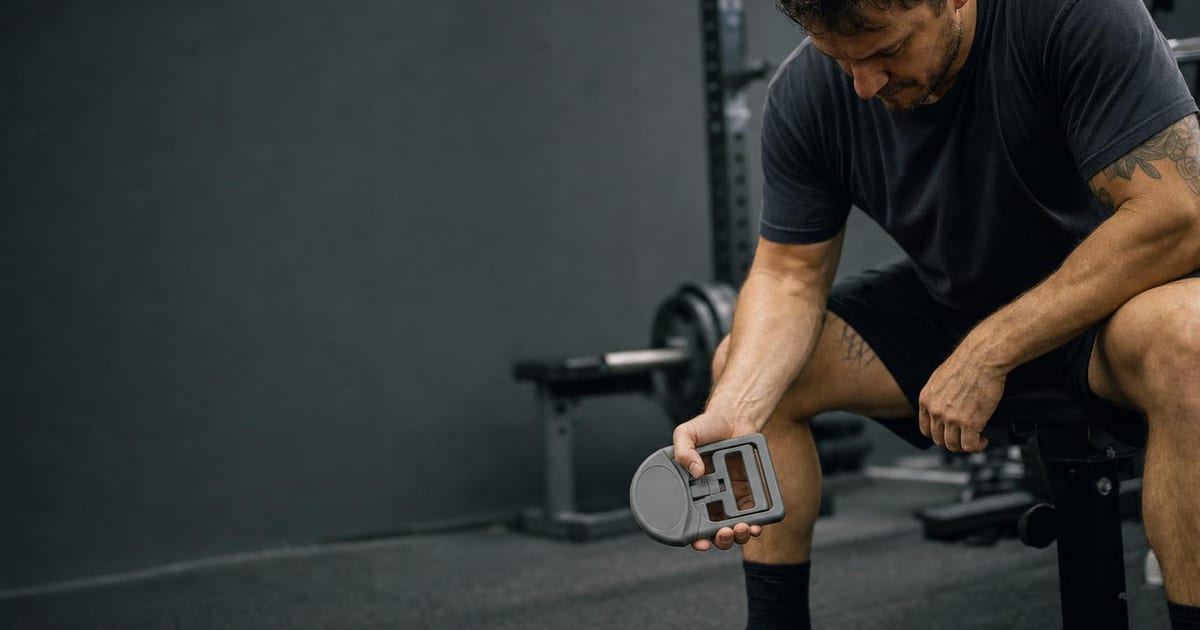
The best digital hand dynamometer for most lifters is the Camry EH101. It costs under $50, reads 0–90 kg (0–198 lb), and has shown excellent agreement with the clinical-standard Jamar in published validation studies. Buy the Jamar Smart Hand Dynamometer (~$385–$440) only if you need Bluetooth capture for clinical records. If your grip is already strong enough to approach 90 kg, a Bluetooth force gauge like the Tindeq Progressor gives you more headroom.
One point most comparison guides skip: a hand dynamometer measures crush grip, while deadlifts mostly test support grip. Either device can give you a useful trend line, but only if you test with a consistent protocol and pair the reading with a support-grip test. This guide covers both.
TL;DR
For tracking grip strength over time, the Camry EH101 (under $50, 0–90 kg, onboard memory) gives you the best value. Research shows it agrees closely with the Jamar while reading slightly lower on average. The Jamar Smart (~$385–$440, 0–90 kgf, Bluetooth to a tablet app) suits clinics. The Tindeq Progressor fits strong lifters who want higher force limits. To log your readings, Kenso (iOS) pairs grip data with your full training history and a Claude-powered AI Coach. Strong, Hevy, and FitNotes are solid simpler alternatives.
Ranked: The Best Grip Strength Testers for Lifters in 2026
1. Camry Digital Hand Dynamometer (EH101)
Verdict: the best value by a wide margin, and the most-studied budget dynamometer available.
- Range: 0–90 kg / 0–198 lb, digital readout with auto-capture of peak force
- Price: typically under $50
- Evidence: one validation study comparing it to the Jamar reported a correlation of R = 0.94 and an ICC of 0.97
2. Jamar Smart Hand Dynamometer
Verdict: the clinical choice if you want digital records and Bluetooth, but overkill for most home users.
- Range: 0–200 lbf (about 0–90 kgf)
- Connectivity: Bluetooth to a tablet app that records, graphs, and tracks tests
- Price: approximately $385–$440
3. Jamar Hydraulic Hand Dynamometer
Verdict: the long-standing research benchmark, though its analog dial makes logging slower than digital options.
- Range: 0–90 kg with an adjustable five-position handle
- Strength: decades of normative data are built on this device
- Trade-off: it needs periodic calibration and costs far more than the Camry
4. Tindeq Progressor (Bluetooth Force Gauge)
Verdict: the best Bluetooth option for strong lifters and grip specialists, with one caveat. It is not a crush-grip dynamometer out of the box.
- Measures pulling force in real time through a phone app, with higher force limits than 90 kg dynamometers
- Works well for isometric pinch, block, and support-style pulls with a loading pin or handle
- Your setup becomes your protocol, so standardize it carefully
5. Squegg Smart Squeeze Ball
Verdict: a Bluetooth squeeze trainer that suits casual tracking, not serious measurement.
- App-connected squeeze ball with session history
- Not validated against the Jamar in the literature reviewed for this guide
- Useful for engagement, but don't treat its numbers like dynamometer data
Device Comparison at a Glance
| Device | Type | Range | Connectivity | Validation vs. Jamar | Approx. Price |
|---|---|---|---|---|---|
| Camry EH101 | Digital dynamometer | 0–90 kg | None (onboard memory) | Strong agreement, reads slightly lower | Under $50 |
| Jamar Smart | Digital dynamometer | 0–90 kgf | Bluetooth (tablet) | Same manufacturer family | ~$385–$440 |
| Jamar Hydraulic | Analog dynamometer | 0–90 kg | None | The reference standard | Several hundred dollars |
| Tindeq Progressor | Force gauge | Model-dependent, above 90 kg | Bluetooth (phone) | Different measurement type | Check current pricing |
| Squegg | Squeeze ball | Varies | Bluetooth (phone) | Not established | Check current pricing |
Camry vs Jamar Dynamometer: What the Research Shows
The Camry vs Jamar question has been studied directly. A study of community-dwelling adults over 50 found the Camry EH101 had excellent reliability and validity compared with the Jamar. The authors concluded it could serve as a practical alternative.
That same study also found Jamar readings were consistently higher than Camry readings. Two practical implications follow:
- Don't compare your Camry number to Jamar-based population norms and conclude you're below average. Some of that gap is the device.
- Never switch devices mid-tracking. A 3 kg drop that appears when you move from a Jamar to a Camry is a measurement artifact, not lost strength.
The key takeaway: consistency of tool matters more than the brand of tool. A $40 device used the same way for two years gives you better data than a $400 device used inconsistently.
The Lifter's Problem: Crush Grip vs Deadlift Grip
If you're shopping for a hand dynamometer for deadlift grip, know what it does and does not capture.
- Crush grip, which is closing the hand, is what every dynamometer on this list measures. It's the standard clinical metric.
- Support grip, which is holding a load against gravity, limits most heavy deadlifts and rows.
- Pinch grip, using the thumb against the fingers, is mostly separate from both.
These qualities are related, but they don't move in lockstep. Your crush grip can plateau while your deadlift hold time keeps climbing, and the reverse also happens.
The fix is simple. Track one crush-grip number and one support-grip number on the same day.
How to Track Grip Strength Progress: A Repeatable Protocol
The protocol below is adapted from the standardized approach described by Roberts and colleagues in Age and Ageing (2011). It's widely used in clinical and epidemiological research.
Crush grip test (dynamometer)
- Sit in a chair without armrests, feet flat, upper arm against your side, and elbow bent to 90 degrees.
- Keep your forearm in a neutral position, with the thumb pointing up.
- Set the handle to the same position every time. On a Jamar, position 2 is the common default.
- Squeeze maximally for about 3 seconds.
- Perform 3 trials per hand, alternating hands, with roughly a minute of rest between trials on the same hand.
- Record the best trial for each hand, plus the device name.
Support grip test (barbell or dead hang)
- Pick a fixed load, for example your bodyweight on a barbell with a double-overhand grip and no straps or chalk changes.
- Hold at lockout for maximum time. Alternatively, do a timed dead hang from a pull-up bar.
- Record the seconds and keep the load identical for future tests.
Testing cadence and conditions
- Test every 2–4 weeks. Weekly testing mostly captures noise.
- Test before training, at the same time of day, and never right after heavy pulls.
- Treat small changes with skepticism. Research consistently suggests grip readings vary meaningfully from day to day, so look at the trend over 3 or more tests, not single sessions.
- Note context such as sleep, a recent deload, or a bodyweight change. Grip is sensitive to fatigue.
How This Fits Into Your Training Log
Logging grip tests alongside your pulls lets you see whether a stalled deadlift is a grip issue or a strength issue. Ask the Kenso AI coach how your grip trend tracks your deadlift once you have a few data points.
Bluetooth Grip Strength Tester vs Manual Logging
A Bluetooth grip strength tester sounds like the obvious upgrade, but think about where the data ends up. The Jamar Smart sends readings to its own tablet app. The Tindeq and Squegg use their own phone apps. None of these sync into a general workout log, so your grip data stays separate from your deadlift, row, and pull-up history.
For most lifters, typing two numbers into a training log every few weeks takes less than a minute. It also keeps everything in one place. Bluetooth earns its cost mainly when you test many people, as clinics and coaches do, or when you want real-time force curves for isometric training, which is where the Tindeq stands out.
Where to Log Your Readings: Best Apps for Grip Strength Tracking
None of the dynamometers above sync directly with mainstream workout apps, so you'll log readings manually. These apps handle that well.
1. Kenso
Verdict: the best fit for lifters who want grip data interpreted in context with their full training history.
- iOS workout logger with a rule-based progression engine
- Claude-powered AI Coach with access to your logged training history
- Apple Health is its only external data source, so dynamometer readings are entered manually
2. Strong
Verdict: a clean, fast logger with excellent history views.
- Custom exercises and routines, plus PR tracking
- Free tier with a Pro subscription
- iOS and Android
3. Hevy
Verdict: a strong all-rounder with social features and a generous free tier.
- Shows previous session values for each exercise
- Free tier with Hevy Pro
- iOS and Android
4. JEFIT
Verdict: a large exercise library and workout plans, though the interface is busier.
- Custom exercises and plans
- Free tier with Elite subscription
- iOS and Android
5. StrongLifts 5x5
Verdict: great for its specific program, but less flexible for custom tests like grip.
- Automatic weight increases built into the 5x5 program
- Free with a Pro upgrade
- iOS and Android
6. FitNotes
Verdict: a minimalist and free option, but Android only.
- Simple custom exercise logging with graphs
- Free
- Android
7. GymBook
Verdict: a tidy iOS logger with good charts.
- Custom exercises and workout templates
- Paid upgrade model
- iOS
| App | Progressive Overload | AI Coaching | Custom Programs | Price | Platform |
|---|---|---|---|---|---|
| Kenso | Rule-based progression engine | Yes (Claude-powered AI Coach) | Yes | See App Store | iOS |
| Strong | History and PR tracking, manual progression | No | Yes (routines) | Free + Pro subscription | iOS, Android |
| Hevy | Previous values shown, manual progression | Not a core feature | Yes (routines) | Free + Pro subscription | iOS, Android |
| JEFIT | Tracking and logs | Limited | Yes | Free + Elite subscription | iOS, Android |
| StrongLifts 5x5 | Automatic within 5x5 | No | Limited | Free + Pro | iOS, Android |
| FitNotes | Manual tracking with graphs | No | Yes (routines) | Free | Android |
| GymBook | Manual tracking with charts | No | Yes (templates) | Paid upgrade | iOS |
App pricing and features change often, so verify current tiers on the App Store or Google Play before subscribing.
How to Choose a Grip Strength Tracker for Lifters
- Match the range to your strength. Most lifters fit within 90 kg, but if you're already squeezing 80 kg or more, choose a device with more headroom.
- Prioritize validation over features. The Camry's published agreement with the Jamar matters more than any app.
- Commit to one device. Switching tools mid-tracking produces false trends, because different dynamometers read differently.
- Track support grip too. Pair the dynamometer with a timed hold if your goal is deadlift grip.
- Keep data in one place. A training log that holds both grip tests and lifts is more useful than a separate grip app you open twice a year.
Frequently Asked Questions
Is the Camry EH101 accurate enough for tracking grip strength?
Yes. Validation studies show excellent reliability and strong agreement with the Jamar, the clinical reference device. It tends to read slightly lower than a Jamar, which doesn't matter as long as you track with the same device every time.
Can I compare Camry and Jamar readings directly?
Not reliably. Research comparing the two found Jamar readings were consistently higher, so mixing devices creates artificial jumps or drops. Pick one device and keep using it.
Does a hand dynamometer predict deadlift grip strength?
Only partially. Dynamometers measure crush grip, while deadlifts mostly depend on support grip. Pair dynamometer readings with a timed barbell hold or dead hang to get the full picture.
How often should lifters test grip strength?
Every 2–4 weeks works well for most people. More frequent testing tends to capture day-to-day noise rather than real change. Test before training, at the same time of day, using the same protocol.
Can Kenso sync with a Bluetooth grip strength tester?
No. Kenso's only external data source is Apple Health, and it does not connect to dynamometers or other hardware. Logging your best reading per hand takes under a minute, and Kenso's AI Coach can then review those entries alongside your training history.
Sources
- Validation of the Camry digital handgrip dynamometer: a cross-sectional study comparing the Camry dynamometer to the Jamar dynamometer (World Physiotherapy congress abstract)
- Reliability and validity of two hand dynamometers when used by community-dwelling adults aged over 50 years (peer-reviewed study comparing the Camry EH101 and Jamar)
- Reliability of the use of Camry versus Jamar dynamometer (peer-reviewed reliability study)
- Roberts HC, et al. A review of the measurement of grip strength in clinical and epidemiological studies: towards a standardised approach. Age and Ageing, 2011.
- BodySpec, Grip Strength Tester: How to Choose and Test (product specs and pricing comparison)
- Apple App Store and Google Play listings for Kenso, Strong, Hevy, JEFIT, StrongLifts 5x5, FitNotes, and GymBook
The Bottom Line
For most lifters, the Camry EH101 is the right purchase. It's inexpensive, validated, and accurate enough to show real trends. The Jamar Smart is excellent but built for clinics. The Tindeq Progressor is the better Bluetooth pick if you've outgrown a 90 kg ceiling or want isometric force data.
The device, however, is only half the system. A consistent protocol, a matching support-grip test, and a log that keeps grip next to your pulls will tell you far more than any single reading. If you want that context in one place, download Kenso on iOS. Log your grip tests alongside your training, and let the AI Coach help you read the trend.
This article contains affiliate links. We may earn a small commission at no extra cost to you.