
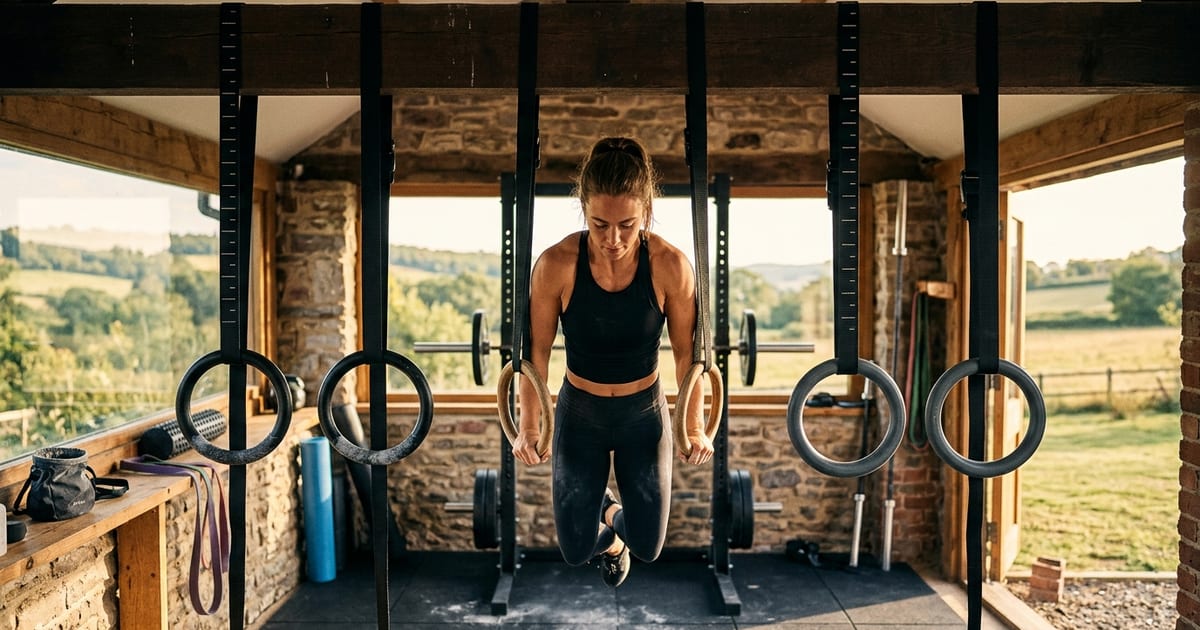
For most lifters, the best gymnastics rings for a home gym are wooden rings with cam-buckle straps, hung from an anchor you have actually checked. Choose 28mm if you want muscle-ups and 32mm if you mostly do dips and rows or have large hands. Wood is porous and takes chalk better than smooth plastic or steel, which helps your grip on false-grip pulls, dips, and long support holds. Plastic is fine on a tight budget or outdoors. Steel suits fixed outdoor installs better than indoor strength training.
Most "best rings" lists rank near-identical wooden sets against each other. The decisions that actually change your training are:
- Your anchor. A well-made ring hung from a weak point is still a weak setup. Dynamic movements like kipping and muscle-ups load the anchor well above your bodyweight. Check the manufacturer's load rating on the rings, then check the beam, joist mount, or rack crossmember they hang from. Doorframe bars built for static hangs are not ring anchors.
- Your grip diameter. Use a simple self-test: on a 28mm ring or bar, set a false grip with your wrist over the ring. If you can hold it without your fingertips jamming into your palm, and muscle-ups are the goal, buy 28mm. If 28mm feels thin and cramped, or you mainly dip, row, and push, buy 32mm. If you can't decide and want muscle-ups, choose 28mm, the FIG (International Gymnastics Federation) competition standard.
Once those two are settled, the leading wooden sets perform similarly. Here are the picks:
- PACEARTH Gymnastics Rings Wooden Olympic Rings with Adjustable Cam Buckle: a solid all-round wooden set with cam-buckle straps for home and garage gyms.
- Double Circle Wooden Gymnastic Rings: a value-focused wooden set.
- Goratic Gymnastic Rings: a budget option. Confirm the grip diameter, material, and strap markings on the listing before you buy.
- Rogue Wood Rings: the premium choice from an established equipment brand, sold direct by Rogue.
Prices and listings checked as of October 2026. Check current pricing and specs on the listing before you buy.
How Gymnastics Rings Work for Strength Training
A pull-up bar and a dip station are fixed. Rings move freely in every direction, so your body has to stabilize the load while it produces force. On a ring dip, the rings try to drift outward and rotate at the bottom. Your shoulder stabilizers, chest, and rotator cuff have to hold the rings close to your torso through the whole range of motion. That stabilization cost is the main difference between ring work and fixed-implement work.
Research on unstable-surface training explains why rings feel harder than a dip station. Behm and Anderson's review (Behm DG, Anderson KG. The role of instability with resistance training. Journal of Strength and Conditioning Research. 2006;20(3):716–722) found that instability raises stabilizer demand and lowers maximal force output. Rings build control first, and maximal strength comes later.
The Canadian Society for Exercise Physiology took the same position in its 2010 position stand on instability resistance training (Behm DG, Drinkwater EJ, Willardson JM, Cowley PM. Applied Physiology, Nutrition, and Metabolism. 2010;35(1):109–112). It concluded that unstable implements raise trunk and stabilizer activation but reduce force output. The authors recommended them as a complement to stable-ground strength training, not a replacement. For lifters, rings are an excellent tool for upper-body pushing and pulling. They won't stand in for your heavy barbell work.
Grip material matters because of friction. Wood is porous and takes chalk. Plastic and steel are smooth and non-porous, so sweat and chalk tend to sit on the surface. The closest research is on climbing, not rings. Amca and colleagues (Amca AM, Vigouroux L, Aritan S, Berton E. Effect of chalk on friction at finger/rock contact in rock climbing. Sports Biomechanics. 2012;11(4):473–479) measured how chalk affects finger friction on rock-climbing holds. They did not test wooden versus plastic rings. Applying their findings to ring materials is an extrapolation. It is consistent with what many coaches report: a surface that holds chalk tends to keep your grip longer. It has not been tested directly on rings.
What the Research Says About Ring Training
Instability changes the stimulus
Kohler, Flanagan, and Whiting (Kohler JM, Flanagan SP, Whiting WC. Muscle activation patterns while lifting stable and unstable loads on stable and unstable surfaces. Journal of Strength and Conditioning Research. 2010;24(2):313–321) compared stable and unstable loads and surfaces during the shoulder press. Force output dropped as instability increased, while some stabilizer muscles worked harder. Ring dips and ring push-ups follow the same pattern. Expect fewer reps at first than you get on parallel bars, and treat that gap as a skill and stability deficit you can train.
Volume and progression still drive results
Rings don't exempt you from the basics. Schoenfeld, Ogborn, and Krieger's meta-analysis (Schoenfeld BJ, Ogborn D, Krieger JW. Dose-response relationship between weekly resistance training volume and increases in muscle mass. Journal of Sports Sciences. 2017;35(11):1073–1082) found a graded dose-response between weekly set volume and muscle growth.
Plotkin and colleagues (Plotkin D, Coleman M, Van Every D, et al. Progressive overload without progressing load? The effects of load or repetition progression on muscular adaptations. PeerJ. 2022;10:e14142) compared adding load with adding reps. Both approaches produced similar hypertrophy and strength gains, with a small edge in squat 1RM for the load-progression group. That matters for ring training, because bodyweight work progresses mainly through reps, tempo, and leverage, not added plates.
Rings are a supplement, not a substitute
Across the instability literature, the consistent conclusion is that unstable implements build control and joint stability. They are not the most efficient way to build peak force. If you squat, bench, and deadlift, rings fit best as accessory work for vertical and horizontal pulling and pushing. They are less useful as a way to load your whole body.
How to Compare Gymnastics Rings: What Actually Matters
Most rings on the market share the same basic design, so a few specs decide the comparison.
Load rating and anchor point
Start here, because it is the only spec that is a safety issue. Check the manufacturer's stated load rating, then check your anchor point. A rated ring hung from an unrated joist, or from a doorframe bar built for static hangs, is the weak link. Dynamic movements like kipping and muscle-ups load the anchor well above your bodyweight.
Grip diameter: 28mm vs 32mm
The FIG competition standard is 28mm. A 28mm ring makes the false grip easier for most hands, and the false grip is essential for ring muscle-ups. A 32mm ring spreads pressure over more of the palm and suits larger hands or lifters who mostly do dips and rows. Use the false-grip self-test above. If you're unsure and the muscle-up is your goal, choose 28mm.
Material: wood vs plastic vs steel
- Wood (birch or beech): takes chalk well, stays comfortable in hot and cold temperatures, and is the usual choice for muscle-ups and long support holds. It can swell slightly if left outdoors permanently.
- Plastic (ABS): cheap, weatherproof, and nearly indestructible. It gets slippery once your hands sweat, which hurts false-grip work most.
- Steel: mostly found in outdoor calisthenics parks and fixed installations. It is durable but smooth, heavy, and temperature-sensitive: cold in winter and hot in sun. For an indoor home gym it offers little benefit over wood.
Straps and buckles
- Cam buckles adjust faster than plain loop buckles and hold securely under load.
- Numbered or marked straps let you set both rings to the same height in seconds. This matters more than most buyers expect, because uneven rings cause asymmetric loading.
- Strap length determines where you can hang the rings. Longer straps reach higher beams or tree limbs.
Gymnastics Ring Picks for 2026
Prices and listings as of October 2026.
PACEARTH Gymnastics Rings Wooden Olympic Rings with Adjustable Cam Buckle
A solid all-round choice for home and garage gym lifters. The wooden grip takes chalk for support holds and false-grip work.
- Material: wood
- Straps: adjustable cam buckle system
- Confirm the grip diameter (28mm or 32mm) on the listing to match your goal
Double Circle Wooden Gymnastic Rings
Pick this set if you want wooden rings and value matters most to you.
- Material: wood
- Suited to both general strength work and skill development
- Confirm the grip diameter on the listing before buying
Goratic Gymnastic Rings
A budget option. Listings vary, so check the specs before you buy instead of assuming them.
- Confirm the grip diameter. If you want a 32mm ring for larger hands or dip-focused training, make sure the listing states it.
- Confirm whether the straps are numbered or marked for symmetric height adjustment.
- Confirm the material. Wood is the better choice for indoor use.
Rogue Wood Rings
The premium choice for lifters who want a set from an established strength equipment manufacturer and plan to use rings for years.
- Material: wood
- Brand: Rogue Fitness, an established maker of strength equipment
- Sold primarily direct at roguefitness.com
- Expect to pay more than budget wooden sets
Gymnastics Rings Comparison Table
| Ring | Material | Standout Feature | Price Tier | Best For |
|---|---|---|---|---|
| PACEARTH Gymnastics Rings Wooden Olympic Rings with Adjustable Cam Buckle | Wood | Cam buckle straps | Budget to mid | Most home gym lifters |
| Double Circle Wooden Gymnastic Rings | Wood | Value | Budget to mid | Value-focused buyers |
| Goratic Gymnastic Rings | Confirm on listing (choose wood) | Budget option; verify diameter and straps | Budget | Budget buyers who check specs |
| Rogue Wood Rings | Wood | Established brand build quality | Premium | Long-term, heavy use |
Price tiers reflect listings as of October 2026.
How to Set Up and Progress on Rings: A Concrete Plan
Rings reward patient, measurable progression more than almost any other piece of equipment. Start at the stage that matches your current strength.
Setup
- Hang the rings about shoulder width apart. The FIG competition spacing is 50cm. Use a rated beam, joist mount, or power rack crossmember.
- For dips and support holds, set the rings at roughly hip height so you can step or jump into the support position. At full dip depth your feet may touch the floor. Either bend your knees and tuck your feet behind you, or raise the rings just enough that your feet clear the floor at the bottom of the dip.
- For ring rows and ring push-ups, lower the rings. The lower they hang, the harder the movement.
Beginner stage: build pushing and pulling before support
If you can't yet hold yourself in a support position, start here.
- Ring rows (pulling): lean back with your arms extended and your body straight, then pull your chest to the rings. Make it easier by standing more upright. Make it harder by walking your feet forward until your body is closer to horizontal. Aim for 3 sets of 8 to 12.
- Ring push-ups (pushing): set the rings a few inches off the floor and do push-ups with your body straight. At the top of each rep, turn the rings out slightly, rotating your thumbs away from your body. This trains the same shoulder position you'll need in the support hold and dips. Once 3 sets of 10 to 12 feel controlled, progress to feet-elevated ring push-ups.
Intermediate stage: support and dips
- Build a support hold before dipping. Aim for 3 sets of 20 to 30 seconds with arms locked and rings turned out slightly.
- Progress ring dips from partial range to full depth, keeping the rings pressed against your sides. A common coaching benchmark is 3 sets of 8 to 10 clean reps before adding load or moving on.
Advanced stage: false grip and muscle-up prep
- Train false-grip hangs and false-grip pull-ups on 28mm rings, starting with 3 sets of 10 to 20 second hangs.
- Use the widely cited coaching prerequisites before attempting a strict ring muscle-up: roughly 8 to 10 strict false-grip pull-ups and 8 to 10 full ring dips. These are practical guidelines, not research-derived thresholds.
- Add one rep, or a few seconds of hold time, per session where you can. When you hit the top of a rep range, progress the leverage or add a vest.
How This Fits Into Your Training Log
Log ring dips, ring rows, and ring push-ups with reps and RPE. Once you hit the top of your rep range, Kenso's rule-based progression engine recommends adding load (for example, a weighted vest) or reps. It also flags when a deload is due. For support holds and false-grip hangs, log each hold as a set and add the duration in a note so you can see the trend.
With Kenso Pro, you can ask the AI Coach to build or adjust a ring progression block based on your logged history. You can also build a ring routine with Kenso's custom program builder and track it session by session.
How to Choose the Right Rings for You
- Muscle-up focused: choose 28mm wooden rings, such as PACEARTH or Double Circle. Confirm the diameter on the listing. The thinner grip makes the false grip far easier to hold.
- Larger hands or dip-heavy training: choose a 32mm wooden set. If you consider Goratic, check that the listing specifies 32mm and wood.
- Budget buyer: any well-reviewed wooden set with cam buckles covers everything most lifters will ever do on rings.
- Lifters buying for the long term: Rogue Wood Rings, if you value brand reputation and plan years of heavy use.
- Outdoor-only setup: plastic is the practical choice. It survives rain and sun, though grip suffers.
- Barbell-first lifters: any wooden set works. Treat rings as an accessory for rows, dips, and push-ups rather than a primary program.
- Complete beginners: any set works. Start with ring rows and ring push-ups before support holds.
Common Concerns and Myths About Gymnastics Rings
Are rings bad for your shoulders?
Rings aren't inherently harmful, but ring dips load the front of the shoulder at deep ranges. Problems usually come from skipping the earlier stages and jumping straight to deep or weighted dips. Build up through ring push-ups and the support hold first, then increase dip depth gradually.
Can rings replace a barbell?
The instability literature, including the 2010 CSEP position stand by Behm and colleagues (Appl Physiol Nutr Metab. 2010;35(1):109–112), suggests rings can't fully replace a barbell for maximal strength, because instability reduces force output. Rings are excellent for upper-body control and hypertrophy. They don't load your lower body or reach the absolute loads a barbell does.
Is plastic really that much worse?
For casual rows and push-ups, the difference is small. For false-grip work, long holds, and muscle-ups, many lifters notice the gap. Sweat on a non-porous surface reduces grip, and wood takes chalk better. That last point comes from practical experience and extrapolation from climbing research on chalk, not from studies on rings.
A Final Word on Choosing Rings
Get the anchor right first, then make the 28mm vs 32mm call with the false-grip self-test. For an indoor home gym, wood is the sensible default. Beyond that, the leading wooden sets perform similarly, so spend your attention on a secure anchor and a structured progression rather than small spec differences.
Rings are one of the most cost-effective upgrades you can make to a home gym, but only if you progress on them deliberately. Log your reps and RPE every session, and record holds as sets with the duration in a note. The trend over months matters more than any single workout. Kenso is built for that kind of long-term, intentional progression.
Frequently Asked Questions
Are wooden or plastic gymnastics rings better for home gyms?
Wooden rings are better for most indoor home gyms. Wood is porous and takes chalk, while plastic gets slippery when your hands sweat. Chalk has been shown to affect finger friction on rock-climbing holds (Amca et al., 2012, Sports Biomechanics 11(4):473–479). Applying that finding to ring materials is an extrapolation, not a direct test. Plastic is cheaper and weatherproof.
What size gymnastics rings should I buy, 28mm or 32mm?
Buy 28mm if muscle-ups are your goal. It is the FIG competition standard and makes the false grip easier. Choose 32mm if you have larger hands, if 28mm feels cramped when you set a false grip, or if you mainly use rings for dips, rows, and push-ups.
What are the best rings for muscle-ups?
Wooden 28mm rings with reliable straps are the best fit. Options include the PACEARTH Gymnastics Rings Wooden Olympic Rings with Adjustable Cam Buckle or Double Circle Wooden Gymnastic Rings, as long as the listing confirms 28mm.
How high should I hang gymnastics rings?
For dips and support holds, hang them at about hip height. Then either bend your knees and tuck your feet at the bottom of the dip, or raise the rings just enough that your feet clear the floor at full depth. For pull-ups and muscle-ups, hang them high enough that your feet clear the floor with your arms extended. For ring rows and push-ups, hang them lower. Keep them about shoulder width apart, which corresponds to the 50cm FIG spacing.
Are ring dips harder than bar dips?
Yes. Instability research, including Behm and Anderson's 2006 review (Journal of Strength and Conditioning Research 20(3):716–722), shows that unstable implements reduce force output and increase stabilizer demand. Most lifters manage fewer ring dips than bar dips at first.
Can beginners use gymnastics rings?
Yes. Start with ring rows for pulling and ring push-ups for pushing, turning the rings out slightly at the top of each push-up. Progress to feet-elevated ring push-ups, then support holds, before attempting ring dips.
How long does it take to get a ring muscle-up?
It varies widely with your starting strength and bodyweight. Lifters who already have roughly 8 to 10 strict false-grip pull-ups and ring dips often need several months of consistent technique work. Starting from scratch can take a year or more.
This article contains affiliate links. We may earn a small commission at no extra cost to you. Prices and listings as of October 2026.