
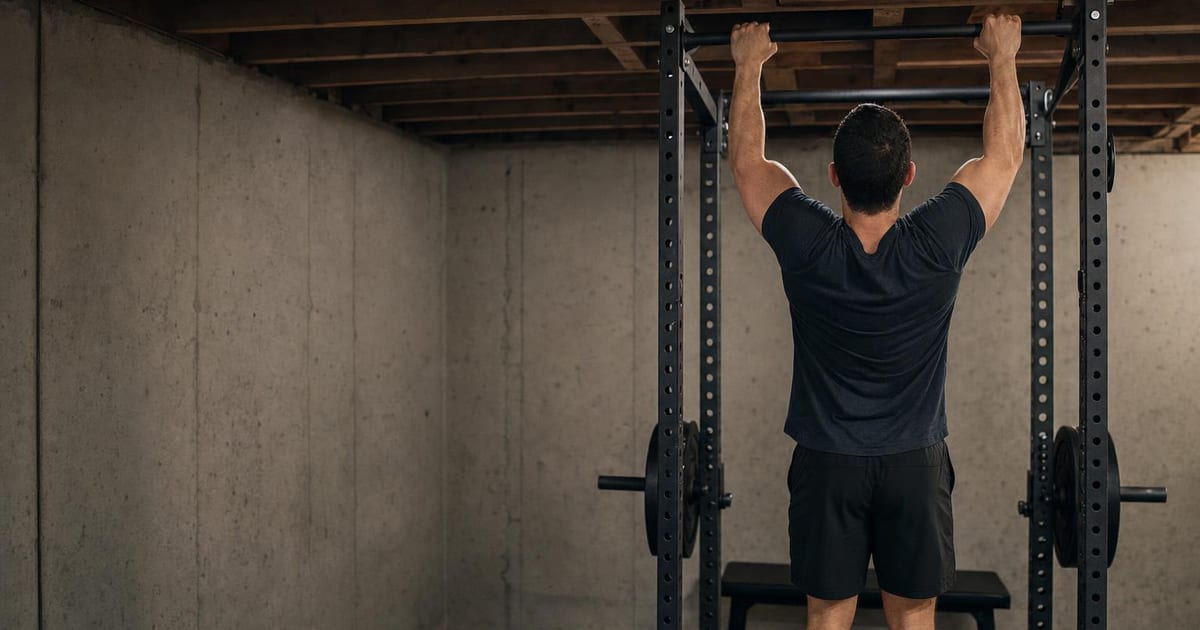
The best power rack for a low ceiling depends on how much headroom you need above the pull-up bar. For a 7-foot (84-inch) ceiling, the Titan T-2 Short is the best pick. At about 71 inches tall, it is the only full cage here that leaves the 10-12 inches above the bar that strict pull-ups need. The REP PR-1000 Short is the best all-around cage if you have about 90 inches or more of usable height, because its short configuration is listed at roughly 80 inches. Racks around 80 inches, including the PR-1000 Short and the 79-inch Body-Solid GPR400, will physically fit under 84 inches but leave only 4-5 inches of head clearance. One caveat applies to every option: your ceiling limits standing barbell overhead press, not your rack. Most lifters with ceilings under 84 inches will need a workaround.
TL;DR
For ceilings between 7 and 7.5 feet (84-90 inches), buy a rack around 71 inches tall. The Titan T-2 Short (about 71 inches, 2x2-inch steel) is the best pick and also sits in the budget price tier. The REP PR-1000 Short is the best overall cage once you have about 90-92 inches of usable height, since its short configuration is roughly 80 inches tall. With about 89-91 inches or more, the 79-inch Body-Solid GPR400 is another sturdy option. The Rogue SML-1 is a compact squat stand of about 70 inches. It has no pull-up bar, and you need to buy spotter arms or safeties separately for solo lifting. Standing overhead press rarely fits under 84 inches regardless of the rack, so plan on seated or dumbbell pressing. Log the change in a training app like Kenso so your progression data stays clean.
The Counterintuitive Rule: Shorter Is Often Better
Most buyers look for the tallest rack that will physically fit. In a low basement, that is usually a mistake.
A power rack's pull-up bar sits at or near the top crossmember. When you pull your chin over the bar, the top of your head rises roughly 8-10 inches above it. Your ceiling therefore needs to be at least 10-12 inches above the pull-up bar, not just above the rack.
The rule used throughout this guide: rack height + 10-12 inches = minimum usable ceiling for pull-ups.
Here is what that looks like with a 7-foot (84-inch) ceiling:
- 71-inch rack: about 13 inches of headroom. Strict pull-ups work.
- 79-inch rack: about 5 inches of headroom. Your head meets the drywall before your chin clears the bar.
- 80-inch rack: about 4 inches of headroom. The rack fits, but pull-ups on the top bar do not.
Here is an illustration of how this plays out. With an 81.5-inch basement ceiling, a rack that just fits under the ceiling leaves almost no room above the bar for pull-ups. Multi-grip pull-up bars, which can add around 6 inches to the rack's height, make it worse.
How to Measure Your Basement Before You Buy
Measure twice and buy once. Basement ceilings are rarely as uniform as they look.
- Find the lowest obstruction, not the average ceiling. Ducts, beams, drain pipes, and soffits often sit 4-8 inches below the drywall.
- Subtract your flooring. Stall mats and rubber gym flooring are typically 3/4 inch thick, so subtract about 1 inch.
- Note the joist direction and spacing if your ceiling is unfinished. Open joist bays can add a few inches, which matters later for pressing.
- Check your lifting spot specifically. You may have 84 inches in the middle of the room and 78 inches near the furnace.
- Leave assembly margin. Uprights are often tilted into place, so allow a few inches beyond the rack's listed height.
Your usable number is the lowest obstruction minus your flooring. If pull-ups matter to you, the rack height plus 10-12 inches should be at or below that number.
How to Choose a Short Power Rack
- Prioritize headroom over rack height. Rack height plus 10-12 inches should be at or below your usable ceiling if pull-ups matter.
- Know your safety needs. A four-post cage is the safer choice for training alone. Squat stands save space but leave less margin for a failed rep, and they usually need separately purchased spotter arms or safeties.
- Plan to bolt down lighter racks. Racks built from 2x2-inch tubing benefit from anchoring, especially if you do kipping or band work. Check the manufacturer's assembly guidance.
- Check attachment compatibility. Confirm hole spacing and tube size so dip bars, landmines, and straps fit later.
- Decide on pressing before buying. If you will press seated, make sure the J-cups go low enough for a seated start position.
- Confirm the listed height on the manufacturer's current product page. Short and tall versions often share a name.
The Best Power Racks Under 80 Inches, Ranked
1. Titan T-2 Short (71-Inch)
Verdict: The best pick for 7-foot ceilings and the best value. It is the only full cage on this list with real pull-up headroom under 84 inches.
- About 71 inches tall. It is also sold in a taller version, so order the short model carefully and confirm the height on Titan's current product page.
- 2x2-inch steel tubing. Gauge listings vary between retailers, so check Titan's current spec sheet.
- Reviews commonly cite an 850 lb rated capacity. Confirm the current figure on Titan's page.
- Pin-and-pipe safeties are standard. Straps are sold separately.
- Best usable ceiling: about 81-83 inches or more.
The 71-inch height is the main selling point. It fits in nearly any basement and leaves about 13 inches of headroom under an 84-inch ceiling.
The trade-offs are real. A lighter 2x2-inch frame flexes more than heavier racks such as Titan's T-3 line, so anchoring it is worth considering. Check Titan's assembly guidance on bolting it down. Pin-and-pipe safeties are slower to adjust than straps and harder on your bar. On the 71-inch version, the pull-up bar is the top crossmember. Because the bar is low relative to their height, taller lifters will do bent-knee pull-ups.
2. REP PR-1000 Short
Verdict: The best all-around cage once you have about 90-92 inches of usable height. It balances build quality, attachment options, and a compact footprint.
- The short configuration is listed at roughly 80 inches. Confirm the exact current figure on REP's product page before ordering.
- Full four-post cage with a top crossmember pull-up bar.
- Sits in a higher price tier than the Titan T-2 Short, with better fit and finish according to reviewers.
- Best usable ceiling: about 90-92 inches or more.
GarageGymScout names the PR-1000 Short its best all-around cage for ceilings under 80 inches. Under an 84-inch ceiling, however, an 80-inch rack leaves only about 4 inches above the bar, which is not enough for pull-ups. Choose it if your usable height is about 90 inches or more and you want a clean, reliable rack without needing to minimize cost.
3. Body-Solid GPR400 Power Rack
Verdict: A sturdy, well-built choice for basements with roughly 89-91 inches or more of usable height.
- Listed at about 79 inches tall. Confirm the current figure on Body-Solid's product page.
- Heavy-duty construction. Garage Gym Reviews calls it a strong option for basements with low ceilings.
- Best for usable ceiling heights of about 90 inches (7.5 ft) or more.
At 79 inches, the GPR400 fits under an 84-inch ceiling, but it will not leave enough headroom for pull-ups at that height. Buy it if your usable height is around 90 inches or more.
4. Rogue SML-1 Squat Stand
Verdict: A compact, high-quality option at about 70 inches. It is a squat stand, not a full cage, and it has no pull-up bar.
- Rogue lists an upright height of about 70 inches. Some reviews round this to 72, so confirm it on Rogue's product page.
- Rogue build quality in a minimal footprint.
- No four-post enclosure and no pull-up bar.
- For solo bench and squat, you need separately purchased spotter arms or safeties.
The SML-1 suits lifters who mostly squat and bench, value a small footprint, and are comfortable without a full cage. If you train alone and want maximum safety, a four-post rack is the better choice. If you choose the SML-1 anyway, budget for spotter arms or safeties.
5. REP PR-4000 (80-Inch)
Verdict: A premium rack worth considering only if you have close to 8 feet of usable height.
- An 80-inch configuration is available.
- Premium feature set and a broad attachment ecosystem.
- At the very edge of low-ceiling territory.
The PR-4000 is an excellent rack, but at 80 inches it needs about 90-92 inches of usable height for comfortable pull-ups. That describes a standard 8-foot basement with no ducts in the way, which is less common than most people assume.
Comparison Table
Best usable ceiling = rack height + 10-12 inches (pull-up headroom).
| Rack | Height | Steel | Pull-Up Bar | Best Usable Ceiling | Price Tier |
|---|---|---|---|---|---|
| Titan T-2 Short | ~71 in. | 2x2 in. (confirm gauge) | Top crossmember | 81-83+ in. | Budget |
| REP PR-1000 Short | ~80 in. (short config) | REP standard | Top crossmember | 90-92+ in. | Mid |
| Body-Solid GPR400 | ~79 in. | Heavy-duty | Top front | 89-91+ in. | Mid |
| Rogue SML-1 | ~70 in. | Rogue standard | None | N/A (no pull-up bar; fits ~72+ in. with assembly margin) | Mid |
| REP PR-4000 (80 in.) | 80 in. | 11-gauge class | Top crossmember | 90-92+ in. | Premium |
Prices change often, so check current listings. The Titan T-2 Short sits in a lower price tier than the REP PR-1000 Short.
The Overhead Press Problem Nobody Mentions
This is where most low-ceiling guides fall short. A short rack does not help you press overhead. Your ceiling decides that.
Here is the math for a standing barbell press. A 5'10 lifter typically has a standing overhead reach of roughly 88-92 inches. At lockout, the bar sits a few inches below fingertip reach, around 85-88 inches. A standard 450 mm (17.7-inch) plate extends nearly 9 inches above the bar's center.
That puts the top of your plates at roughly 94-97 inches. Under an 84-inch ceiling, standing barbell press with full plates will not fit for most adults. Pressing outside the rack does not change that.
Practical Workarounds That Actually Work
- Seated barbell press. Sitting on a bench lowers lockout height by roughly 15-20 inches, which brings it under most 7-foot ceilings. Use a rack with a low enough J-cup setting for a seated start.
- Seated or standing dumbbell press. Dumbbells are much smaller in diameter than barbell plates. A seated dumbbell press fits almost anywhere.
- Half-kneeling landmine press. The arc of the bar keeps it well below the ceiling, and many lifters find it easier on the shoulders.
- Press in an open joist bay, with care. With an unfinished ceiling, 2x10 joists give you about 9 inches of extra height between them. Standard 16-inch-on-center joists leave bays only about 14.5 inches wide, while a 450 mm plate is 17.7 inches across.
- If the bar runs parallel to the joists, the plates are wider than the bay and will hit the joists.
- The bar must run perpendicular to the joists, and each plate must sit fully within a bay.
- Your joist spacing may not line up with the plate positions on the bar.
- A PVC pipe test in the exact spot is mandatory before loading the bar.
- You may need smaller-diameter plates or dumbbells instead.
- Z press. Pressing seated on the floor removes leg drive entirely and fits in the lowest spaces.
Pick one replacement and stay with it for at least a full training block. Switching between variations every week makes your pressing progress impossible to read.
Step-by-Step Fit Check Before You Order
Use this sequence with your usable height measurement. Each tier is based on rack height + 10-12 inches.
- Under 81 inches: No rack on this list leaves full pull-up headroom. The Titan T-2 Short fits physically, but you will have under 10 inches of head clearance above the bar (only about 9 inches at 80). The Rogue SML-1 fits but has no pull-up bar. Plan on seated pressing and a separate pull-up solution or rowing variations.
- 81-88 inches: Choose the Titan T-2 Short. Pull-ups work with 10-17 inches of headroom. Pressing should be seated or done with dumbbells. The 79-80-inch racks fit physically but leave under 10 inches above the bar.
- 89-91 inches: The GPR400 gains workable pull-up headroom. The 80-inch racks are marginal at the low end of this range. The Titan T-2 Short gives very comfortable clearance.
- 92 inches or more: The REP PR-1000 Short, GPR400, and REP PR-4000 at 80 inches are all good options with comfortable pull-up headroom.
Then test your pressing plan with a broomstick or PVC pipe in the exact spot where you will lift. Two minutes of testing is cheaper than a hole in the drywall.
How This Fits Into Your Training Log
If your ceiling forces a switch from standing to seated press, log seated press as a separate exercise in Kenso. Kenso's rule-based double-progression engine then generates weight and rep recommendations for it independently, so old standing-press numbers don't distort them. Each exercise page also shows that lift's estimated 1RM trend. Set up seated press as its own lift in Kenso.
Making Low-Ceiling Training Work Long Term
A low basement changes your exercise selection, not your ability to progress. With the right rack, squats, bench press, deadlifts, rows, and pull-ups all fit under 84 inches. The only lift that consistently needs adapting is the overhead press.
The lifters who do well in these spaces treat the constraint as a programming decision. They pick a pressing variation, stay with it, and measure progress against that lift alone. Consistent variation choice is what makes the data meaningful, whether you review your history in a notebook or ask the Kenso AI Coach how your seated press is trending.
Frequently Asked Questions
What height power rack fits a 7-foot ceiling?
A rack around 71 inches tall, such as the Titan T-2 Short, is the best fit for a 7-foot (84-inch) ceiling. That leaves about 13 inches above the pull-up bar, which is enough for strict pull-ups. A 79- or 80-inch rack, including the REP PR-1000 Short, will fit physically, but your head will hit the ceiling during pull-ups.
Can you do pull-ups on a 71-inch power rack?
Yes, but most adults will need to bend their knees to hang freely, because the bar is low relative to their height. Strict bent-knee pull-ups work well, while kipping is impractical. You also need roughly 10-12 inches of space between the bar and your ceiling, so a 71-inch rack needs about 81-83 inches of usable height.
Can you overhead press under an 80-inch ceiling?
Standing barbell overhead press usually will not fit. For an average-height lifter, lockout height plus plate radius often exceeds 94 inches. Seated barbell press, seated dumbbell press, landmine press, and Z press are all workable alternatives. In an unfinished ceiling, an open joist bay can add a few inches. Full-size plates only clear the joists if the bar runs perpendicular to them and each plate sits within a bay, so always test with PVC first.
Is the Titan T-2 Short sturdy enough for heavy lifting?
The Titan T-2 Short uses 2x2-inch steel tubing, and reviews commonly cite an 850 lb rated capacity. Confirm the current gauge and capacity on Titan's product page. That is enough for most home lifters. It does flex more than heavier racks, so anchoring it is worth considering. If you lift very heavy, want more stability, and have about 90 inches or more of usable height, the REP PR-1000 Short is a step up.
How do I measure my basement ceiling for a power rack?
Measure from the floor to the lowest obstruction in your lifting area, including ducts, beams, and pipes. Subtract about 1 inch for rubber flooring. Then confirm that the rack height plus 10-12 inches is at or below that usable height.
Should I log seated press separately from standing press?
Yes. Seated and standing press use different amounts of leg and trunk contribution, so your working weights will differ. Tracking them as separate exercises keeps your progression history accurate and makes it clear when you are actually getting stronger.
Sources
- GarageGymScout, "Best Squat Racks for Low Ceilings 2026: Compact, Short, and Foldable Options Reviewed" (garagegymscout.com)
- Garage Gym Reviews, "Best Squat Racks (2026) Personally Tested" (garagegymreviews.com)
- Manufacturer product pages:
- Titan T-2 Short (retail listing) and Titan Fitness
- REP Fitness (PR-1000, PR-4000)
- Rogue Fitness (SML-1)
- Body-Solid (GPR400)
Start Tracking Your Training With Intention
The right short rack opens up nearly every major lift in your basement. Kenso is an iOS workout logger with a rule-based progression engine, an AI Coach (Kenso Pro) that can read your training history, and Apple Health sync. Download Kenso on the App Store and track the estimated 1RM trend for each lift, so you can see exactly how your seated press, squat, and pull-ups progress block to block.
This article contains affiliate links. We may earn a small commission at no extra cost to you.