
Chalk Ball vs Chalk Block vs Rosin for Powerlifting: Which Grip Aid Survives a Full Training Session Without Reapplication?
For powerlifting, chalk blocks (magnesium carbonate) are the most reliable grip aid for surviving a full training session without constant reapplication — particularly on deadlifts and squats where bar contact is prolonged and sweat accumulation is highest. Chalk balls offer a cleaner, more controlled application and hold reasonably well for moderate-intensity sessions, while block rosin delivers exceptional initial tack but can become slippery as it builds up across multiple sets. If you train in a gym that prohibits loose chalk, liquid chalk is the practical workaround that most closely mimics block chalk longevity.
TL;DR: Which Grip Aid Should You Use?
For serious powerlifting sessions, Rogue Gym Chalk (block format, $14 for a 2-block set) is a consistent performer across deadlifts, squats, and bench — and it's a competition standard. If your gym bans loose chalk, liquid chalk is generally the best long-lasting liquid alternative, since a single application tends to hold up across a full session. Chalk balls like the Primo Chalk Ball ($25) sit between the two: less mess, but slightly less grip intensity than raw block chalk. Block rosin is a niche choice — powerful tack, but not universally permitted.
Why Grip Aid Format Actually Matters for Powerlifting
Most lifters treat chalk as an afterthought — something you slap on your hands before a heavy set. But the format of your grip aid determines how often you're breaking between sets, how your grip degrades across a two-hour session, and whether you're even allowed to use it in competition.
When it comes to choosing chalk for deadlifts, the stakes are higher than in most other strength sports. A deadlift with 90%+ of your max leaves almost no margin for grip slip. The difference between chalk that lasts three sets and chalk that lasts eight sets is the difference between a productive session and a frustrating one.
Here's a structured breakdown of each format.
Chalk Balls: Consistent Application, Moderate Longevity
What They Are
Chalk balls are mesh or fabric pouches filled with loose magnesium carbonate. You squeeze them to release a controlled dusting of chalk onto your hands. The Primo Chalk Ball is a commonly cited option in powerlifting communities — it's refillable, produces less airborne mess than block chalk, and is permitted in most commercial gyms that technically ban "loose chalk" (the ball contains it).
Grip Performance
Chalk balls apply a lighter, more even coat than block chalk. For most lifters, this means:
- Reapplication window: Roughly every 2-3 heavy sets
- Best for: Moderate-load sessions, accessory work, gyms with chalk restrictions
- Weakness: Under maximal loads with prolonged bar contact (think: a slow deadlift grind), the lighter coating can thin out faster than block chalk
Verdict on Longevity
Chalk balls are a solid middle ground. They won't carry you through a full 10-set deadlift session without reapplication, but the reapplication process is fast and low-mess. For lifters who train in commercial gyms or value tidiness, this is a reasonable trade-off.
Chalk Blocks: The Competition Standard for a Reason
What They Are
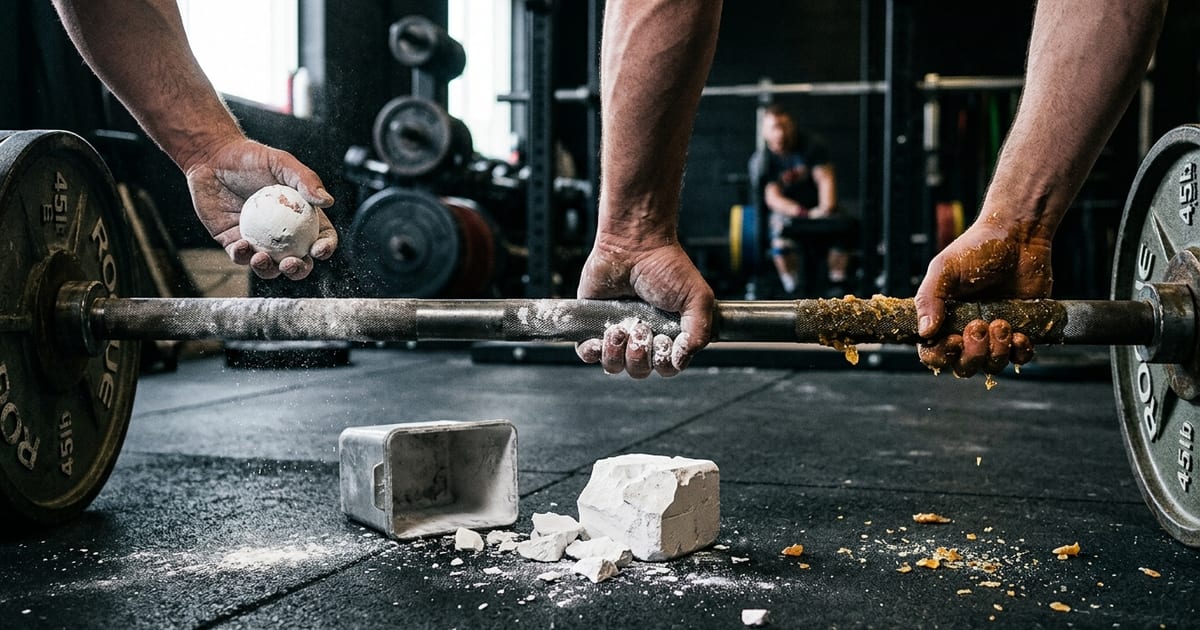
Block chalk is a solid brick of magnesium carbonate — the same substance used in gymnastics and climbing. You rub it directly onto your hands, generating a thicker, more deliberate coating. Rogue Gym Chalk is a widely used block option among powerlifters, and it's what you'll find at virtually every sanctioned powerlifting meet.
Grip Performance
Block chalk outperforms chalk balls in raw grip longevity because the application is thicker and more targeted. You control exactly where it goes — palm, fingers, or both — which matters when you're pulling sumo versus conventional.
- Reapplication window: Roughly every 4-6 heavy sets
- Best for: Maximal deadlifts, competition prep, high-volume pulling sessions
- Weakness: Messy. Block chalk produces visible dust, which is why many commercial gyms prohibit it outright
Magnesium carbonate chalk is universally permitted in major powerlifting federations including USAPL, IPF, and USPA. It also does not damage barbells — and because magnesium carbonate absorbs moisture, it can reduce standing moisture on the bar surface rather than leaving it wet.
Verdict on Longevity
For a full powerlifting session — warm-ups through top sets across squat, bench, and deadlift — block chalk is the most reliable format. It requires reapplication, but less frequently than chalk balls, and the application itself is faster once you develop a routine.
Block Rosin: High Tack, High Variability
What It Is
Block rosin (also called pine rosin or grip rosin) is a resinous compound derived from pine sap. It creates a tacky, almost sticky surface on the hands rather than a dry, friction-based grip like magnesium carbonate. It's commonly used in baseball, gymnastics, and some strongman events.
Grip Performance
Rosin behaves differently from chalk in a few important ways:
- Initial tack: Significantly higher than chalk. The first set after application often feels noticeably more secure
- Accumulation problem: Unlike chalk, rosin doesn't evaporate or wear off cleanly. It builds up across sets, and as it accumulates with sweat, it can transition from tacky to slippery — the opposite of what you want mid-session
- Reapplication window: Technically longer than chalk, but the quality of grip degrades rather than simply fading
- Best for: Single heavy attempts, short sessions, or specific events where maximum initial tack is the priority
Federation Rules
This is where rosin becomes complicated for powerlifters. While magnesium carbonate is universally permitted, rosin is not allowed in IPF/USAPL competition. Rules for other federations vary, so if you're training for a specific federation, verify its current rulebook before making rosin part of your competition prep routine — you don't want to train with a grip aid you can't use on the platform.
Verdict on Longevity
Rosin is not the best choice for a full powerlifting session. Its grip quality is inconsistent across a high-volume training day, and the federation restrictions make it impractical for most competitive lifters. It has a niche use case — specific strongman implements or one-rep-max attempts — but it's not a daily driver.
Liquid Chalk: The Commercial Gym Solution
Liquid chalk deserves mention here even though it's not a "block" format, because it's the most direct alternative when your gym prohibits loose chalk. As a category, liquid chalk is valued for longevity — a single application often holds up across a full session, including across multiple exercises.
Liquid chalk works by suspending magnesium carbonate in an alcohol base. The alcohol evaporates quickly, leaving a chalk coating that adheres more firmly than loose chalk. The trade-off is that it takes 20-30 seconds to dry after application, and some lifters find it slightly less grippy than raw block chalk at true maximal loads.
On pure longevity per application, liquid chalk is the standout — but it's not the strongest grip format available.
Side-by-Side Comparison: Reapplication and Performance
| Format | Reapplication Frequency | Grip Strength | Mess Level | Competition Legal (IPF/USAPL) | Approx. Price |
|---|---|---|---|---|---|
| Chalk Ball (Primo) | Every 2-3 heavy sets | Moderate | Low | Yes | ~$25 |
| Chalk Block (Rogue) | Every 4-6 heavy sets | High | Medium | Yes | ~$14 (2-block set) |
| Block Rosin | Every 3-5 sets (degrades) | Very High (initially) | Low | No (IPF/USAPL) | ~$8-12 |
| Liquid Chalk | Once per session | Moderate-High | Very Low | Yes (most feds) | ~$15 (4 oz) |
The Concrete Recommendation for Powerlifters
If you train in a home gym or a facility that permits chalk: use Rogue Gym Chalk blocks. Apply chalk to your full palm and wrap your fingers around the block for 3-4 seconds per hand. Reapply before your top sets and any set where you're pulling above 85% of your max. This approach will carry you through a standard 90-120 minute powerlifting session with 3-4 reapplications total.
If your gym prohibits loose chalk: use liquid chalk. Apply one thin coat, wait 20-30 seconds for the alcohol to evaporate, and you're set for the session. Keep it in your bag for touch-ups on particularly sweaty days.
If you compete in strongman or a federation that permits rosin: use block rosin selectively — for your heaviest single attempts only, not as your primary session-long grip aid.
How This Fits Into Your Training Log
If you're tracking grip-dependent lifts like deadlifts and rows, you can note your grip aid in Kenso's session notes — useful for spotting patterns when your pull numbers stall on high-volume days.
How to Choose the Right Grip Aid for Your Training Context
- Check your gym's rules first. Many commercial gyms prohibit loose chalk (blocks and balls) but permit liquid chalk. Using the wrong format means getting kicked out mid-session — not a useful experiment.
- Match the format to your session length. For sessions over 90 minutes with high pulling volume, block chalk's longer reapplication window pays off. For shorter sessions or accessory-focused days, a chalk ball is sufficient.
- Consider your competition federation. If you compete in IPF or USAPL, rosin is off the table. Train with what you're allowed to use on the platform.
- Factor in the mess. If you share a platform or train with others, chalk balls and liquid chalk are more considerate options. Block chalk generates visible dust that settles on equipment.
- Don't over-apply. More chalk is not always better. Excess chalk can actually reduce friction by creating a slippery layer. A thin, even coat on the palm and fingers is more effective than a heavy application.
Tracking Grip Performance Over Time
One underrated aspect of grip aid selection is that its effect on your training is measurable — if you're logging your sessions consistently. Lifters who track their deadlift sets in detail often notice patterns: grip failures cluster on high-volume days, on days when they skipped chalk, or when they switched formats without adjusting their application routine.
Kenso's training log lets you add session notes and track set-by-set performance, which makes it straightforward to correlate grip aid choices with pull consistency over weeks of training. This isn't about obsessing over chalk — it's about having enough data to make informed decisions when something isn't working.
Conclusion
The rosin vs chalk for grip debate often gets framed as a matter of preference, but for powerlifting specifically, the answer is more structured than that. Block chalk is the most practical, competition-legal, and session-durable option for the majority of lifters.