
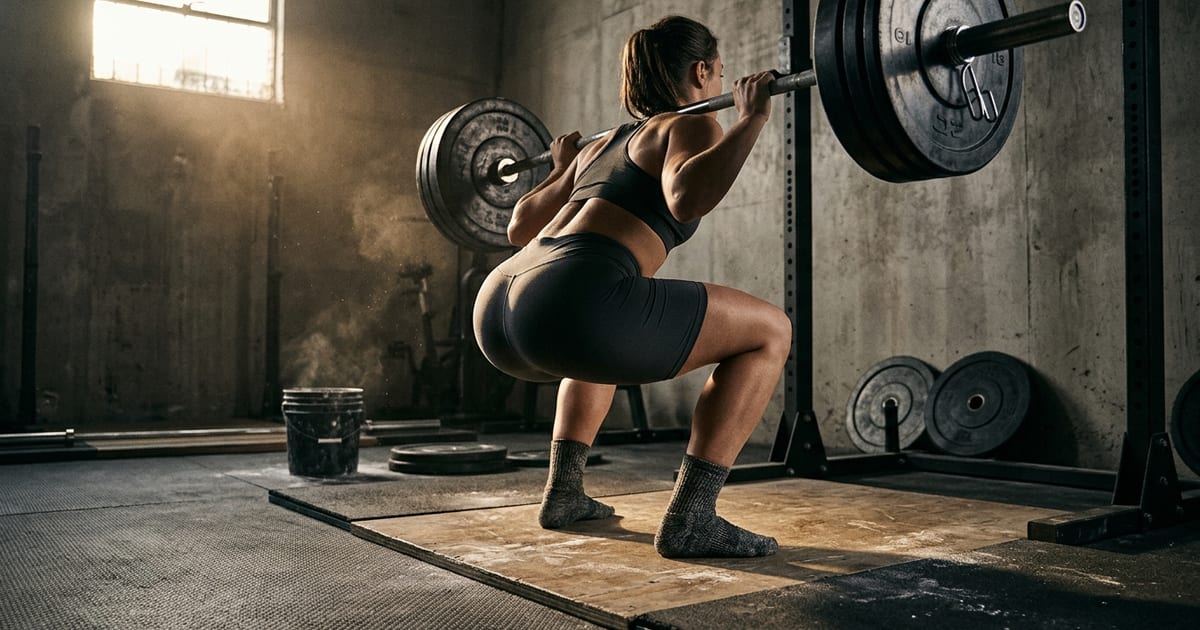
Compression shorts do not reliably increase squat strength or maximal muscle output. The research suggests their real benefits are smaller and more specific: better proprioception (your sense of where your joints are), less muscle oscillation, and modest help with recovery. If they make your squat feel more stable, that is a valid reason to wear them. Just don't expect them to change your numbers, and if you want to know whether they help you, test reps at a fixed load rather than trusting how they feel.
What the Research Says About Compression Shorts and Lifting
Most compression research focuses on running, jumping, and recovery. Very little looks at heavy barbell squats. The findings that do exist point in a consistent direction.
- Recovery shows the clearest benefit. Born, Sperlich, and Holmberg's 2013 meta-analysis, "Bringing light into the dark: effects of compression clothing on performance and recovery" (International Journal of Sports Physiology and Performance), found small effects on some performance measures. It found larger effects on recovery markers, including reduced delayed-onset muscle soreness (DOMS) and lower blood creatine kinase (a marker of muscle damage).
- Proprioception may improve. Hong WH, Lo SF, Wu HC, and Chiu MC (2022), "Effects of compression garment on muscular efficacy, proprioception, and recovery after exercise-induced muscle fatigue onset for people who exercise regularly," PLoS ONE 17(2):e0264569, reported effects on proprioception and recovery after fatigue. This is the most relevant mechanism for squatting, with one caveat. The study used a fatigue protocol, not heavy barbell squats, so applying its findings to squatting is an inference, not a direct result.
- Maximal strength gains are not established. No strong body of evidence shows compression adds load to a 1RM or increases force output in a meaningful way.
Why Compression Wear Proprioception Matters for Squats
The squat is a positional lift. Knee tracking, hip depth, and bracing all depend on body awareness. Constant pressure on the skin gives your nervous system more sensory input, so many lifters report feeling more "locked in" at the bottom.
That feeling is real, but feeling stable and producing more force are different things. Better awareness might help you hit depth more consistently or keep your knees on track during the last reps of a hard set. It won't make you stronger.
The Blinding Problem: Why "Feels Better" Isn't Proof
Compression research has a flaw that most summaries skip. You cannot blind someone to wearing compression. In a drug trial, half the participants get a sugar pill and nobody knows who got which. With compression shorts, everyone knows within a second whether they're wearing them.
So the expectation effect is built into every study, and into your own experience too. If you believe compression helps, a set can feel easier even when your output is identical. Felt benefits and measured benefits can diverge, and the felt one is the less reliable of the two.
This is why a self-test should not ask "did it feel better?" It should ask a harder question: at the same load, did you complete more reps, or the same reps at a lower RPE? Reps at a fixed load are much harder to talk yourself into.
How to Test Compression Shorts in Your Own Training
Your own data is more useful than anecdotes. Run a simple four-week comparison:
- Pick one squat variation and one fixed test load you can handle at around RPE 8. Keep this load the same for every test set for the whole four weeks, even if your regular program progresses around it. Normal progression pushes reps up and RPE down over time. If the load changes, you can't tell compression effects apart from getting stronger.
- Alternate by session, in a counterbalanced order. Use A for compression and B for regular shorts, and follow a pattern like A-B-B-A-A-B-B-A across your squat sessions. Session-level alternation gives you more data points than alternating weeks. The counterbalanced order means neither condition always lands on your "fresher" or "stronger" days, so a gradual training trend doesn't favor one side.
- Log your test set in Kenso as usual: reps completed, weight and RPE. Kenso records the session date automatically. Kenso doesn't have a session-note or tag field, so keep a simple list of which dates you wore compression outside the app, in your phone's notes or on paper.
- Compare after four weeks. Average your reps and RPE for each condition at the test load. As a practical rule of thumb, treat a difference under about one rep or one RPE point as noise. RPE itself varies roughly ±0.5–1 from day to day, even when nothing has changed.
Keep the sample size in mind. Four weeks of squat sessions gives you only a handful of sets per condition. Treat the result as a personal signal about what seems to work for you, not proof that compression works or doesn't.
If you want to try a pair, three options:
- Under Armour Men's HeatGear Armour Compression Shorts, about $30. A firm fit at an entry-level price.
- 2XU Men's Core Compression Shorts, about $55–65. A firmer fit from a compression-focused brand.
- Nike Pro Men's Dri-FIT Shorts, about $30. Lighter compression that works well under regular shorts.
Size for snug, not restrictive. You should be able to reach full hip flexion without the waistband rolling.
How This Fits Into Your Training Log
Kenso records the data this test needs: reps, weight, RPE and session dates for every set you log.
Holding your test load constant is simpler when your other training is predictable. Kenso's double-progression engine is rule-based, not AI. It gives consistent weight and rep recommendations from your logged sets, so the rest of your program stays steady while you keep the squat test set fixed.
For the comparison itself, use the AI Coach. It is part of Kenso Pro ($5.99/month or $49.99/year; code EARLY gives you 1 month free). The coach can read your training history, but it can't tell which sessions used compression unless you say so. After four weeks, tell the Kenso AI Coach which dates you wore compression and ask it to compare your reps and RPE at the test load. For example: "I wore compression shorts on these dates: [list]. Compare my squat reps and RPE at 120 kg on those days against my other squat sessions in the same period."
The Bottom Line
Compression shorts are a comfort and feedback tool, not a strength tool. They may help you feel more stable and recover a bit better, but your squat will improve through consistent progression over months. Because you can't blind yourself to wearing them, judge them by reps at a fixed load rather than by feel. Wear them if your logs show they help, and skip them if your logs show no difference.
FAQ
Do compression shorts help lifting performance?
They don't meaningfully increase strength. Research suggests modest benefits for proprioception and recovery, which may help squat consistency more than maximal output.
Is the proprioception benefit of compression wear proven?
Some studies, including Hong et al. (2022), report proprioceptive effects. That study used a fatigue protocol rather than heavy barbell lifts, so the evidence is promising but limited for squatting.
Should I wear compression shorts during or after training?
The recovery research favors wearing them around training. For squats, wearing them during the session is the best way to get any proprioceptive benefit.
How tight should compression shorts be for squatting?
They should be snug enough to feel pressure but loose enough to allow full depth without rolling, pinching, or limiting hip flexion.
Your next step: Pick your fixed test load and log your test sets in Kenso for four weeks, alternating compression and regular shorts in an A-B-B-A pattern. Then give the AI Coach (Kenso Pro) your compression dates and ask it to compare reps and RPE at that load. Kenso is available on iOS.
This article contains affiliate links. We may earn a small commission at no extra cost to you.