
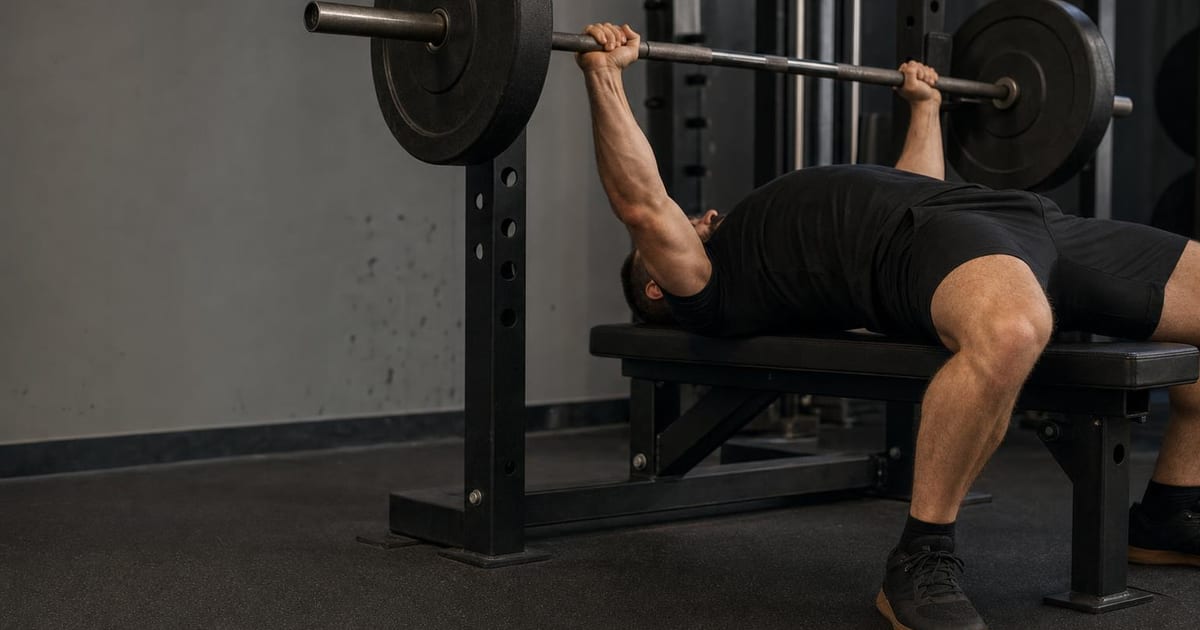
Yes, shoes matter for bench press, but less than technique and more than most lifters assume. The best shoes for bench press have a flat, firm, grippy sole that lets you push your heels into the floor without sliding, which keeps leg drive consistent from rep to rep. Instead of guessing which shoe is best for you, this guide shows you how to test whether a shoe actually changes your bench with a simple four-session A/B comparison. A heeled weightlifting shoe helps some lifters, especially those who struggle to keep their heels down with their feet tucked back (often because of limb proportions or ankle mobility) and those competing in federations that require heels down. It is an option to test, not an automatic upgrade.
Why Your Shoes Affect Bench Press Leg Drive
Leg drive mainly works indirectly: it pushes your upper back into the bench, holds your arch, and keeps your body tight while you press. Your shoes are the only point where that drive meets the floor.
Three shoe variables change how well that works:
- Sole grip: If your feet slide even slightly under load, you lose tension partway through the rep.
- Sole compression: Soft foam deforms under load, making foot position less stable and leg drive less consistent rep to rep.
- Heel height: A raised heel changes your ankle angle, which changes how far back you can set your feet.
Flat vs Heeled Shoes for Bench Press
Flat shoes
Flat shoes are the most common choice. They give a thin, stable platform and let you pull your feet back while keeping heels planted. The Converse Chuck Taylor All Star (approx. $65) and the Vans Old Skool (approx. $70) are long-standing options because their rubber soles grip well and barely compress.
Weightlifting shoes for bench
A heeled weightlifting shoe raises the heel so you can tuck your feet farther back while your heels stay down. Lifters who struggle to keep their heels down with feet tucked back, often because of limb proportions or ankle mobility, may find it easier to stay tight this way. Options include the Reebok Legacy Lifter III and the Nike Romaleos 4, both approx. $200 or more. Heel heights vary by model, so check the manufacturer's spec page for the exact figure before you buy.
Prices are approximate as of the publish date and change often.
The tradeoff: a heel can push your feet into a position that feels cramped, and some lifters find it reduces their leg drive rather than improving it.
What the federation rules say about your feet
Foot rules differ by federation, so check the one you compete in:
- IPF: The IPF Technical Rules (bench press section) require the soles and heels of the shoes to stay in contact with the platform or blocks throughout the lift.
- USAPL: USAPL left the IPF in 2021 and publishes its own rulebook on usapowerlifting.com. Read the foot rule in the bench press section of the current edition rather than assuming it matches the IPF wording.
- Other federations: Some federations, such as USPA, have allowed heels up as long as the feet stay in contact with the floor. Confirm the current wording in the USPA rulebook, since whether you need heels down depends on where you compete.
Rulebooks are revised regularly, so confirm the current edition before a meet.
How to Choose: A Shoe Test
Don't decide based on how a shoe feels in the warm-up. Run a controlled comparison:
- Set your foot position the same way every time. Standardize it with a fixed reference, such as heels directly under the knees, or heels a fist-width behind the knees when viewed from the side. If your setup changes, the test means nothing.
- Pick a reference set. Use a fixed load, like a top set of 5 at roughly RPE 8.
- Alternate shoes across sessions. Use an A/B/A/B pattern over four bench sessions (shoe A, shoe B, shoe A, shoe B). Keep load, warm-ups, and rest periods identical. Alternating spreads normal progression and fatigue across both shoes, unlike a straight week 1 vs week 2 comparison.
- Or compare within one session. Do two back-off sets at identical load and rest, one in each shoe, and switch which shoe goes first next session.
- Record each set. Note reps, RPE, and whether your feet moved.
If one shoe consistently gives you the same reps at a lower RPE, or more reps at the same RPE, across the alternating sessions, that's a meaningful signal. Keep in mind that four sessions is a small sample and day-to-day RPE commonly varies by roughly ±0.5–1, so treat small differences (one rep or half an RPE point) as noise unless they repeat over another A/B cycle.
How This Fits Into Your Training Log
Free: Fix your A/B schedule in advance (for example, bench sessions 1 and 3 = shoe A, sessions 2 and 4 = shoe B) so the session date tells you which shoe you wore. Alternatively, build two otherwise identical custom sessions in Kenso and use one per shoe. Log the reference set every session with its RPE, compare reps and RPE across the two conditions, then check the bench press e1RM trend on the exercise page to see whether it moved after the switch.
Kenso Pro ($5.99/month or $49.99/year): Ask the Kenso AI Coach whether your bench changed between shoes. The AI Coach reads your logged sets, RPE, and e1RM history, but it can only compare shoes if you tell it which sessions used which shoe, such as the dates or your A/B schedule. Tell the AI Coach which sessions used each shoe and ask it to compare reps and RPE on your reference set.
Bench Press Foot Position Matters More Than Brand
A $200 shoe won't fix inconsistent foot placement. Most bench leg drive problems come from feet set in a different spot each session, or from lifters pushing up with their hips instead of back toward their head. Pick a shoe, then lock in a repeatable setup.
Kenso's rule-based double-progression engine recommends weight and rep changes from your logged sets, so equipment-driven swings in reps or RPE can skew its recommendations. Keep shoes and setup constant once chosen.
Conclusion
Shoes matter for bench press because they control how reliably your feet hold tension. For most lifters, a flat, grippy, firm-soled shoe is the right default. Heeled shoes are worth testing if you compete under heels-down rules or struggle to get your feet back. Start in flat shoes, and run the four-session A/B test before spending $200 on a heeled pair.
Frequently Asked Questions
Can I bench press in running shoes?
You can, but cushioned running shoes compress under load and often have less grip on smooth floors. Most lifters notice more stable leg drive in a flat, firm sole.
Are squat shoes good for bench press?
They can be. The raised heel helps some lifters keep heels down with feet tucked back, but others find the heel makes their setup feel cramped. Test both before deciding.
Do I need special shoes for a powerlifting meet bench?
Not necessarily. Any shoe that lets you meet your federation's foot rule comfortably works, and some competitors use heeled shoes to make heels-down easier. See the federation rules section above and check the current rulebook before your meet.
Should I bench barefoot or in socks?
Socks on a smooth floor tend to slide, which undermines leg drive. Barefoot on a grippy floor or platform can work for some lifters, but many gyms and federations require footwear. Grippy shoes are the most consistent default.
How do I know if my shoes are hurting my bench?
Watch for feet sliding mid-rep, losing your arch as the bar moves, or RPE creeping up at the same load. Logging each session makes those patterns easier to spot.
This article contains affiliate links. We may earn a small commission at no extra cost to you.