
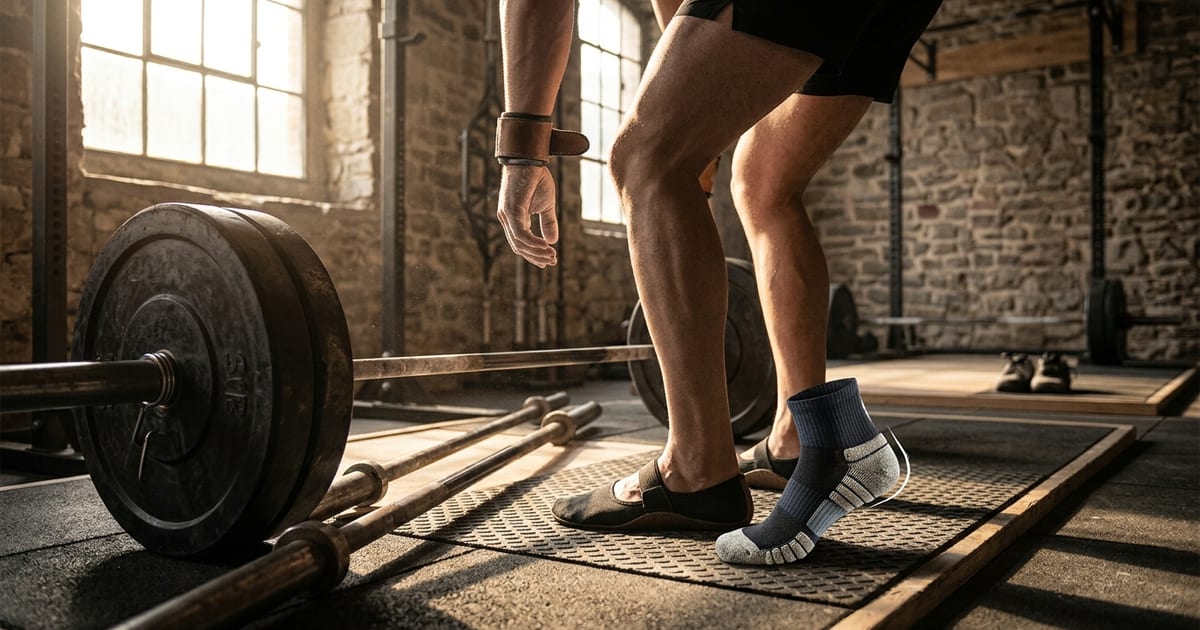
For squats and deadlifts, the best gym sock thickness is thin to light cushioning under the foot. A thin footbed keeps your foot flat, connected to the floor, and locked inside your shoe. If you want shin protection for deadlifts, get it from a tall, durable cuff, not from a thicker footbed.
Most lifters control their stance, grip, belt, and shoes, then pull on whatever socks are clean. That makes socks one of the few equipment variables that changes from session to session without anyone noticing. Kenso's view is simple: anything between your foot and the floor is part of your setup, so keep it as consistent as your stance width.
This article contains affiliate links. We may earn a small commission at no extra cost to you.
Why Sock Cushioning Matters for Lifting
Many lifters and coaches prefer firm, flat soles because cushioned soles compress under load. Your sock adds its own layer to that equation, and it's the layer most likely to change between sessions.
A plush footbed adds a compressible layer under your heel and forefoot. It also takes up volume inside the shoe, so your foot can shift, or the shoe no longer fits the way it did when you laced it last week. You may notice this most in the bottom of a squat.
A quick rule of thumb: put on the sock and lace your lifting shoe to its usual tightness. If you have to loosen the laces, or the eyelets close up differently than normal, the sock is too thick for that shoe. Your lifting socks should leave your shoe fit unchanged.
Thin vs Thick Gym Socks: What Changes
Deadlift feel
- Thin socks: you feel the floor clearly. Pressing through mid-foot is easier to sense, and your setup stays the same from rep to rep.
- Thick socks: the floor feels softer and less precise. Some lifters say their first pull feels "mushy" off the floor.
- The real deadlift need is shin coverage. The bar drags along your shins, so a knee-high or over-calf cuff matters more than cushioning.
Competitive powerlifting reflects this priority. Major federations such as the IPF and USAPL require socks that cover the shins during the deadlift, partly for hygiene in case the bar scrapes skin and draws blood. Rulebook wording changes, so check your federation's current technical rules before a meet. Either way, the rule concerns cuff length, not footbed padding.
Squat stability
- Thin to light cushion: less movement inside the shoe and steadier pressure through the whole foot.
- Heavy cushion: more room for the foot to shift. This becomes more noticeable as you get closer to your top sets.
A Practical Lifting Sock Guide
Match sock thickness to your shoe. Flat lifting shoes and weightlifting shoes are built to fit snugly. Use the lacing check above. If a sock changes how the shoe laces, save it for another day.
Treat cuff height and padding as two separate choices. Deadlift-specific socks such as MOXY Deadlift Socks or SBD Deadlift Socks pair a knee-high, durable cuff with a thin footbed. That gives you shin coverage without extra padding underfoot.
Keep cushioned socks for conditioning days. A sock like the Feetures Elite Max Cushion suits running or long walks better than heavy singles.
Change one variable at a time. If you switch socks and shoes in the same week, you won't know which change affected your lifts.
Run a two-week test. Wear the new socks for every lower-body session. Then compare the two weeks before and after the switch:
- RPE at the same working loads
- Sets and reps completed at the same weight
- Your session energy ratings
Also write down any notes on foot pressure or setup consistency in whatever tool you prefer.
How This Fits Into Your Training Log
A sock change is an equipment variable worth checking against your actual numbers. Kenso logs your sets, reps, weight, RPE, and energy, so you have a baseline on both sides of the switch. After two weeks, download Kenso, then ask the AI Coach (Pro) to compare your squat and deadlift sessions from before and after the change.
The AI Coach is part of Kenso Pro ($5.99/month or $49.99/year). Use code EARLY for 1 month free.
The Bottom Line
Socks won't add kilos to your total. What they can do is remove a small source of instability that varies from session to session.
- For squats, choose a thin or light footbed.
- For deadlifts, add a tall cuff.
- Keep the same pair for your main lifts.
In Kenso, the double-progression engine sets your weight and rep targets each session, and you log RPE against them. That gives you a clean before/after baseline. If you hit the recommended reps at a lower RPE after the switch, the new socks are helping. If RPE climbs at the same loads, they aren't.
FAQ
Are thin or thick socks better for deadlifts?
Thin to light footbeds keep floor feel consistent. Choose a tall cuff for shin protection rather than extra padding under the foot.
Do thick socks make squats less stable?
They can. Heavy cushioning adds a compressible layer and can let your foot shift inside snug lifting shoes, especially under heavier loads.
Do I need special deadlift socks?
Not strictly. Any tall, durable sock covers your shins. Deadlift-specific socks combine that cuff with a thin footbed and a locked-in fit. If you compete, check that your socks meet your federation's current deadlift sock rule.
Should I wear the same socks for every lifting session?
For main lifts, yes. Keeping your equipment the same makes your logged performance easier to compare from week to week.
Train with intention. Download Kenso for iOS to log every session and follow a rule-based progression engine. Upgrade to Kenso Pro ($5.99/month or $49.99/year, code EARLY for 1 month free) to get answers from an AI Coach that knows your training history.