
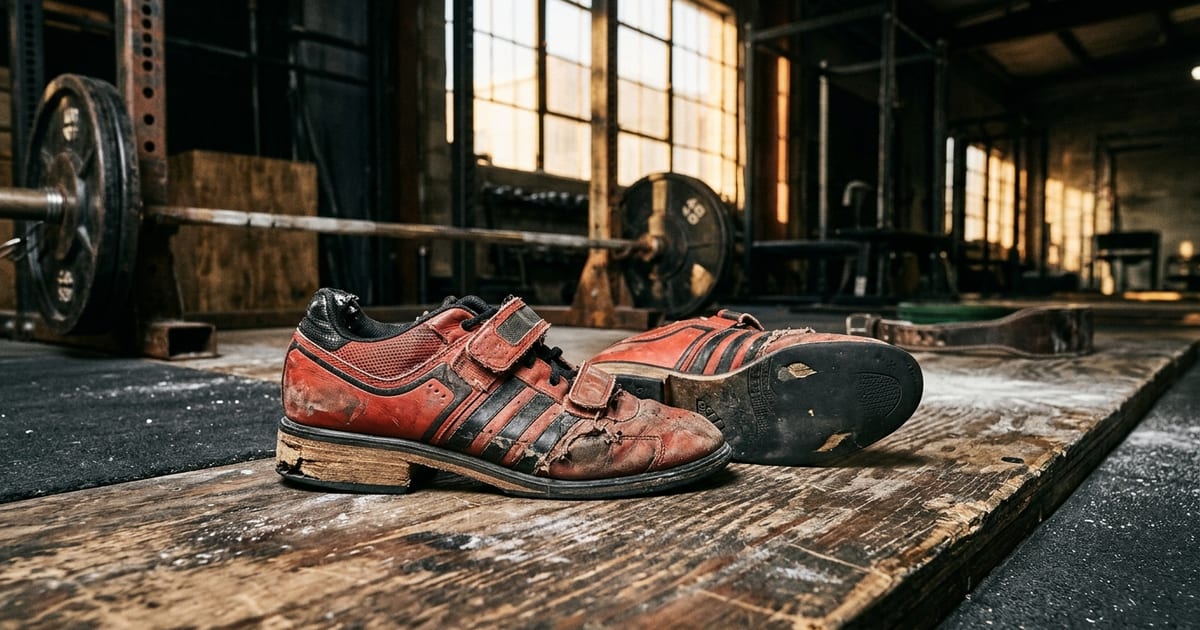
Weightlifting shoes generally last several years. A reasonable expectation is 3–5 years at 3–4 training sessions per week, and platform-only pairs that are stored well can last considerably longer than 5 years. These figures are typical durability expectations drawn from manufacturer guidance and lifter experience, not tested data. Don't go by age alone. Replace them when the heel compresses unevenly, cracks, tilts to one side, or the sole starts separating from the upper.
Lifting shoe lifespan varies so much because it depends on two things: heel material and usage pattern. A rigid TPU heel can stay level for years, while a foam heel slowly compresses under load. How you use the pair matters just as much. A pair worn for squats twice a week can outlast one worn daily for warm-ups, rowing, and walking around the gym.
This article contains affiliate links. We may earn a small commission at no extra cost to you.
Why Heel Material Determines Lifting Shoe Lifespan
Most modern lifters use rigid TPU or dense plastic heels. Examples include the TYR L-2 Lifters, Nike Romaleos 4, and adidas Adipower Weightlifting 3. These heels rarely compress in a meaningful way. They usually fail at the glue line, the upper, or the outsole first.
Budget and hybrid shoes often use EVA or foam heels. Those do compress, and they compress fastest on whichever side takes more load. If your shoe has a foam heel, heel compression is your main durability concern.
Some traditional lifters use stacked wood or leather heels. These don't compress the way foam does, but they can crack or delaminate, and they are sensitive to moisture. If they get wet, dry them at room temperature away from direct heat, and inspect the heel stack for gaps between layers before your next heavy session.
5 Signs Your Squat Shoes Are Worn Out
- The heel tilts when viewed from behind. Set both shoes on a flat table at eye level. If either heel leans inward or outward, the platform under your foot is no longer level.
- The two heels measure differently. Measure each shoe with a ruler the same way: from the floor to the top of the heel at the back edge. There's no validated cutoff here, but as a practical heuristic, a visible or measurable left/right difference (a couple of millimetres is a sensible trigger to investigate) is worth a closer look, since an uneven base may contribute to your weight shifting to one side.
- The heel gives under thumb pressure. A rigid heel should feel like a brick. If you can press a dent into it, or it rebounds slowly, the material has broken down.
- You see cracks or the sole is separating. Check the seam where the heel meets the midsole and the edges of the outsole. A small separation will spread under heavy loads.
- The heel counter or strap no longer locks you in. Squeeze the back of the shoe side to side. If it collapses easily, or the strap can't hold your midfoot down, your foot is shifting inside the shoe under the bar.
How to Make Weightlifting Shoes Last Longer
- Wear them only for squats, Olympic lifts, and front-loaded work. Change into other shoes for walking and conditioning.
- Air them out after each session, and don't leave them in a hot car or trunk.
- Check them every three months using the five tests above.
How This Fits Into Your Training Log
Suppose you notice your squat depth or bar path changing for no obvious reason. The shoe may be the variable. Kenso can't see your depth or bar path, but it gives you something to compare against: your logged load, reps, RPE, and progression trend for every squat session.
Kenso doesn't track gear, so you'll need to record when you start using a new pair. Write the date down (or tell the AI Coach directly).
Use your log as a shoe "mileage" counter. Age is a weak proxy for wear. A better one is how many heavy sessions the pair has carried. Once you know the purchase date, count the squat and Olympic-lift sessions you've logged in Kenso since then, using your workout history and exercise charts. Pair that count with the quarterly five-point check. If the session count keeps climbing and one of the checks starts to look borderline, inspect more often. If your squat trend has flattened at the same time, that's a stronger reason to test a fresh pair.
Download Kenso and tell the AI Coach the date you started training in your current pair. It can review your logged squat history before and after that date to see when a stall began. The AI Coach is part of Kenso Pro ($5.99/month or $49.99/year), which you can buy in the App Store or on kensoforge.com. Use code EARLY for 1 month free.
The Bottom Line
A good pair of lifters is a multi-year investment, but only while the heel stays level and rigid. Run the five checks every quarter, and replace the pair as soon as one clearly fails.
Log every squat session in Kenso so that a heel-related stall or a drift in your load and RPE stands out against your own history. If you note when you started using a pair, your history shows how many squat sessions you've logged since then, alongside your strength trend. Kenso's rule-based double-progression engine recommends your next weight and reps from your logged performance (it doesn't know about your shoes). Your log shows whether a plateau began around the time your shoes started to wear.
FAQ
How long do weightlifting shoes last with regular training?
A reasonable expectation is 3–5 years at 3–4 sessions per week, based on typical manufacturer and user experience rather than tested data. Platform-only pairs that are stored well can last considerably longer than 5 years.
Do TPU heels compress like foam heels?
No. Rigid TPU heels rarely compress. They more often fail at the glue line or the upper. EVA and foam heels compress gradually and often unevenly.
Can worn-out squat shoes affect my lifts?
They can. An uneven or soft heel changes your base of support. That can show up as weight shifting to one side or inconsistent depth.
Should I replace lifting shoes if the strap breaks?
Not necessarily. If the heel and sole are still sound, a cobbler can often repair or replace the strap for much less than a new pair costs.