
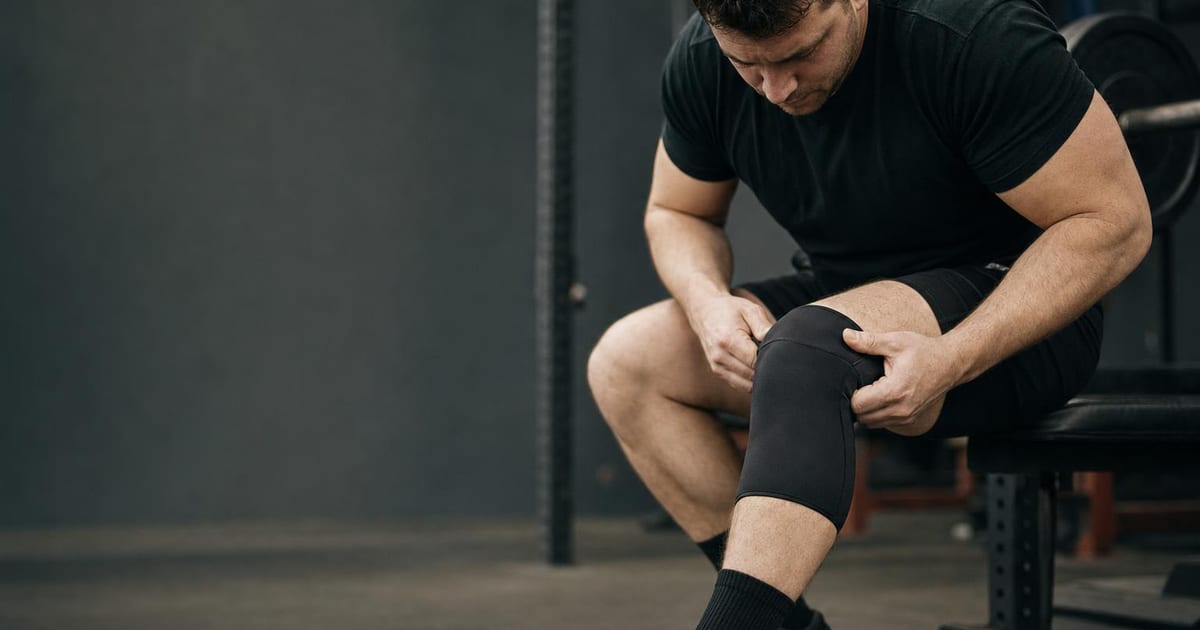
Knee sleeves should feel firmly snug: noticeably compressive and a little hard to pull on, but never numbing, pinching, or painful over a full session. For most lifters, your true size is the right choice. That size comes from your knee circumference, measured at the center of the kneecap. Size down one size only if you want maximum stiffness for short, heavy squat sets and plan to take the sleeves off between sets.
Knee sleeve sizing gets a lot of conflicting advice. The useful approach is to treat sleeve tightness as a tool you match to the job, not a contest to wear the smallest pair.
Disclosure: This article contains one affiliate link (the Amazon link below). We may earn a small commission at no extra cost to you. The other product links are direct, non-affiliate links.
What Knee Sleeves Actually Do
Neoprene knee sleeves do three practical things:
- Warmth. They keep the joint warm, which many lifters find makes the first heavy sets feel smoother.
- Feedback. They give proprioceptive feedback, a clearer sense of where the knee is through the squat.
- Rebound. When worn tight, they add a modest elastic rebound out of the bottom.
In practice, most lifters describe that rebound as small, and many report that a tighter pair feels springier out of the hole than a looser one. Treat that as a lifter observation, not a measured effect. Sleeves support training. They don't replace strength or technique, and there is no reliable figure for how much weight they add to a squat.
How to Take a Knee Sleeve Circumference Measurement
Your measurement decides everything, so take it carefully:
- Use a soft tape measure, not a metal one.
- Stand with weight evenly on both feet and your thigh relaxed. Flexing the quad inflates the number.
- Wrap the tape around the center of your kneecap. Some brands specify a slight bend, around 30 degrees, so check the chart for the sleeve you're buying.
- Keep the tape flat and snug, but don't compress the skin.
- Measure both knees twice and use the larger result.
Then compare it to that brand's chart, not a general one. Charts vary between manufacturers, and a medium in one brand can fit like a large in another.
Most sizing guides skip one detail: brands don't all measure the same thing. Their charts can differ on two points:
- Knee position. Some ask for a straight, relaxed leg. Others ask for a slight bend.
- Measurement point. Some use a single circumference at the kneecap. Others use circumferences a set distance above and below the knee.
Measuring "your knee" one way and reading it against a chart built on another method is a common cause of a wrong size. Before you compare numbers, read the measuring instructions on the size guide for the exact product you're buying. Each brand linked below publishes its own guide.
Should I Size Down Knee Sleeves?
Sizing down is a legitimate choice with a narrow use case. Here's a practical framework:
- True size: everyday training, high-rep work, and sessions where the sleeves stay on for 60+ minutes. Expect firm compression with full range of motion.
- One size down: heavy singles, doubles, and triples, or powerlifting meets. These are the situations where stiffness out of the hole matters and the sleeves come off between attempts.
- Two sizes down: not recommended. Sleeves that small can restrict circulation and press unevenly on the kneecap, which works against the stability you were after.
| Fit | Best use | Wear time | Off between sets? | Risk |
|---|---|---|---|---|
| True size | General training, high-rep work, long sessions | Full session (60+ min) | No | Low |
| One size down | Heavy singles, doubles, triples; meets | Top sets and attempts only | Yes | Moderate: discomfort, hard to put on |
| Two sizes down | Not recommended | — | — | High: restricted circulation, uneven kneecap pressure |
Takeaway: Default to your true size. Size down at most once, and only for short heavy sets with the sleeves off between sets.
If your measurement sits right between two sizes: the smaller size already counts as your "one size down" heavy pair, and the larger size is your true-size everyday pair. Do not go a further size smaller than the smaller of the two, because that would put you two sizes down. Some lifters own both pairs.
If you compete: check your federation's current rulebook before buying a sized-down competition pair. The IPF Technical Rules, for example, allow only sleeves from the approved list. Those sleeves must be single-ply neoprene, no more than 7mm thick and no more than 30cm long. Rules can change between editions and differ across federations, so confirm against the current version.
What Does a Good 7mm Knee Sleeve Fit Feel Like?
This guide focuses on 7mm sleeves because they are the stiffest common option and the usual choice for heavy squatting. 5mm sleeves are more flexible and easier to wear for long sessions, Olympic lifting, or general training. 7mm sleeves give more support and rebound under heavy load.
A 7mm neoprene sleeve is stiff by design. A correct fit should pass four checks:
- No tingling, numbness, or skin color change below the knee during a session.
- No pinching behind the knee in a full-depth bodyweight squat.
- The sleeve stays centered on the kneecap without sliding down during sets.
- Indentation marks fade within a few minutes of taking the sleeves off.
If you fail any of these, go up a size.
Well-regarded 7mm options:
- SBD Knee Sleeves (direct link)
- Rehband Rx Knee Sleeve 7mm (affiliate link)
- Gymreapers Knee Sleeves (direct link)
Each brand publishes its own chart and measuring method, so measure before ordering.
How to Put On Tight Knee Sleeves
The rolling method saves time and wrist strain. Take your shoes off first.
- Turn the sleeve inside out.
- Slide it over your foot and pull the inner half up your shin until its edge sits just below the knee. Let the rest of the sleeve hang down toward your ankle.
- Make sure the edge on your upper shin is straight and settled.
- Grab the hanging outer half and flip it up over your kneecap and onto your thigh.
- Adjust so the kneecap sits centered in the sleeve.
A little chalk or a light dusting of talc on dry skin helps a very tight pair slide on.
How This Fits Into Your Training Log
A practical check on sleeve fit is whether your squat comfort and numbers stay consistent across sessions. In Kenso, log RPE on your top squat sets. You can switch a setting to enter RIR instead. Then watch the squat e1RM trend on the exercise page.
After a switch, steadier top sets at the same load or a holding or rising e1RM trend are consistent with a pair that suits you. They can't be put down to the sleeves alone, because normal progression, fatigue, and readiness all move those numbers too. Compare sessions at similar loads and similar readiness, and treat the result as a rough signal, not proof.
Kenso has no equipment or sleeve-size field, so note the date you switched sleeves yourself. With Kenso Pro, you can then ask the AI Coach to compare your squat sessions before and after that date. It can look at load, volume, and RPE across your training history.
The Bottom Line
Measure at the center of the kneecap, start with your true size, and reserve a smaller pair for heavy, short sets. Fit is right when the sleeve feels supportive and stays forgettable for the whole session. Over a training year, consistent, comfortable sessions matter far more than squeezing into the smallest size available.
Kenso is built for lifters who want to see how load, volume, and effort show up in long-term progression. Download Kenso to log every session, let the progression engine plan your next step, and keep the data behind your decisions.
Time-limited: Kenso Pro Lifetime is a one-time payment with no subscription. It costs $79.99 (US) through Dec 1, 2026 and $129.99 from Dec 2. You'll find it in the app under Settings → Account → Lifetime Pro. Buying Lifetime does not cancel an existing Pro subscription. Cancel that separately in Settings → Account → Manage Subscription.
Frequently Asked Questions
Can knee sleeves be too tight?
Yes. Numbness, tingling, skin discoloration below the knee, or pain behind the knee mean the sleeve is too small. Go up a size.
Should knee sleeves be hard to put on?
A stiff 7mm sleeve in the right size takes some effort, especially a sized-down pair. If you can't get it on with the rolling method, it's likely too small.
Where do you measure for knee sleeves?
Around the center of the kneecap with your leg relaxed. Follow the specific brand's instructions about standing straight, using a slight knee bend, or measuring above and below the knee.
Do knee sleeves stretch out over time?
Neoprene tends to loosen somewhat with regular use and washing. That's one reason some lifters choose a snugger fit at purchase. Still, stay within one size of your true measurement.
Should I wear knee sleeves for every session?
No. Most lifters reserve them for heavy squat and lower-body work and train lighter sessions without them.