
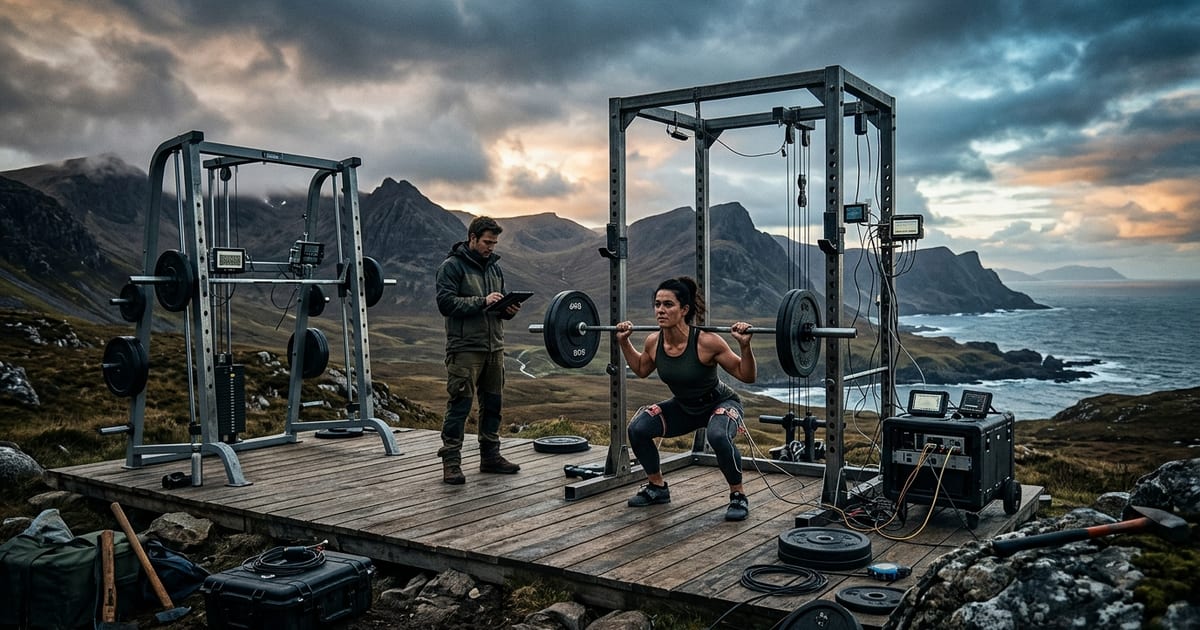
Yes, at least for the knee extensors. In a 2026 randomized crossover study, 19 trained men performed 4 sets of 9 squats at 70% of 1RM with either free weights or a Smith machine. Velocity loss and perceived effort were similar, but the free-weight session produced significantly more central and peripheral fatigue in the quadriceps afterward.
This is a useful piece of strength training research because it separates two things lifters often treat as one: how hard a session feels and how much fatigue it actually leaves behind. The headline is not that one squat is better. It is that two sessions can feel identical and still carry different recovery costs.
Key Finding
When sets, reps, and relative load were matched, free-weight squats and Smith machine squats produced the same bar-speed decline and the same subjective sense of effort. Post-session testing told a different story. The free-weight condition caused greater impairment both in the muscle itself (peripheral fatigue) and in the nervous system's ability to drive the muscle (central fatigue).
The authors conclude that because the two modalities tend to produce comparable strength and hypertrophy adaptations, the Smith machine may be the more efficient choice when limiting knee-extensor fatigue is a priority.
Study Details
The study was published in the International Journal of Sports Physiology and Performance by Marcos-Frutos, Martos-Arregui, García-Ramos, and Márquez.
- Participants: 19 young, strength-trained men (mean age 23.5 years; mean training experience 4.7 years)
- Design: Randomized crossover. Each participant completed both conditions on separate days
- Session: 4 sets of 9 repetitions at 70% 1RM, differing only in squat modality
- Mechanical fatigue: Velocity loss across sets, plus pre- to post-session changes in isometric force
- Perceptual fatigue: Self-estimated repetitions in reserve (RIR)
- Neuromuscular fatigue: The twitch interpolation technique during isometric single-leg knee extension
Twitch interpolation is the methodological strength here. By electrically stimulating the muscle during a maximal voluntary contraction, researchers can estimate how much force loss comes from the muscle fibers versus reduced neural drive. RIR and bar speed cannot make that distinction.
Results
The findings fall into two groups.
What did not differ
- Velocity loss during the sets was not significantly different between conditions
- Perceived fatigue, measured through estimated RIR, was not significantly different
- The reported p-values for these comparisons ranged from .136 to .313
What did differ
- Most peripheral fatigue markers were significantly greater after free-weight squats
- Most central fatigue markers were also significantly greater after free-weight squats
- These differences reached significance at p-values between less than .001 and .021
In practical terms, lifters could not feel the difference, and their bar speed did not reveal it either. The extra fatigue only showed up under laboratory neuromuscular testing.
Why the Fatigue You Cannot Feel Matters
This is the most interesting angle of the paper. Most autoregulation tools, including RIR, RPE, and velocity loss, are designed to estimate how close you are to failure within a set. They are good at that job. This study suggests they may be less informative about the residual fatigue a session leaves in a specific muscle group.
The study did not identify a mechanism, but a reasonable hypothesis is the stabilization demand of free-weight squatting. Controlling the bar path in three dimensions likely requires more total muscular and neural effort per rep, even when the load and rep count are identical. That additional cost would not necessarily change how a set feels near failure.
Limitations
The findings are informative, but they have clear boundaries.
- Narrow population. All 19 participants were young, trained men. Results may differ for women, older lifters, or beginners whose free-weight technique is less established.
- Knee extensors only. Fatigue was measured in the quadriceps. The study does not tell us whether glutes, adductors, hamstrings, or trunk muscles followed the same pattern. A Smith machine may simply shift demand rather than reduce it overall.
- Single, acute session. The study measured fatigue immediately after one workout. It did not track how long the difference persists, whether it affects performance 24 to 72 hours later, or whether it changes long-term adaptation.
It is also worth noting that the efficiency conclusion depends on the assumption of comparable adaptations. Research consistently suggests that free-weight and machine training produce broadly similar strength and hypertrophy outcomes, with strength gains tending to be most specific to the modality you train. That assumption was not tested in this study.
What This Means for Your Training
This is not a case for abandoning the barbell squat. It is a case for treating squat variations as tools with different fatigue costs. Here is how to apply it.
- Use the Smith machine where fatigue is the bottleneck. If you squat two or three times per week, consider making one session a Smith machine squat. A typical split might be a heavy free-weight squat on Monday and Smith machine squats at moderate load, around 3 to 4 sets of 8 to 10, later in the week.
- Keep free weights where specificity matters. If you compete in powerlifting or test a barbell 1RM, the free-weight squat remains your primary lift. Strength is specific to the movement you train.
- Consider the Smith squat when quads are pre-fatigued. On leg days that also include lunges, leg press, or knee extensions, a lower-fatigue squat variation may let you complete more quality work afterward.
- Do not rely on RIR alone to judge recovery. Since perceived effort did not differ here, your next-session performance is a better fatigue indicator. If your squat or leg press numbers stall after free-weight sessions, that is useful data.
- Log the variations separately. Smith machine and free-weight loads are not interchangeable. Treat them as distinct exercises with their own progression histories.
- Run a simple self-experiment. Over a 4 to 6 week block, alternate which modality you use on your second squat day and compare how your following sessions perform.
How This Fits Into Your Training Log
Because Kenso's AI Coach can read your full training history, it can compare how your sessions perform after free-weight versus Smith machine squat days. Ask the Kenso AI coach whether a Smith squat day fits your program.
The Bigger Picture
Evidence-based training rarely produces a single winner. More often, it clarifies trade-offs. This study adds one: at matched load and volume, the free-weight squat appears to cost the quadriceps more neuromuscular fatigue than the Smith machine squat, without feeling any harder.
For most lifters, the practical answer is to use both deliberately. Free-weight squats build skill and carry over to barbell strength. Smith machine squats may let you accumulate useful quad volume at a lower recovery cost. In Kenso, logging each variation as its own exercise keeps both progression histories clean, so the rule-based progression engine can adjust each one on its own terms.
Frequently Asked Questions
Do Smith machine squats build as much muscle as free-weight squats?
Research consistently suggests that machine and free-weight training produce broadly similar hypertrophy when effort and volume are comparable. This specific study measured fatigue, not muscle growth, so it does not directly answer that question.
Why did free-weight squats cause more fatigue if they did not feel harder?
The study did not test a mechanism. One plausible explanation is that stabilizing a free bar requires extra muscular and neural effort per rep, which adds fatigue without noticeably changing how close a set feels to failure.
Should powerlifters switch to the Smith machine?
No. Strength is specific to the movement trained, so competitive lifters should keep the free-weight squat as their primary lift. A Smith machine squat may be useful as a lower-fatigue secondary variation.
Does this mean RIR is unreliable?
Not within a set. RIR still estimates proximity to failure reasonably well. This study suggests it may not capture differences in residual muscle fatigue between exercises, so pair it with next-session performance data.
Do these results apply to women and beginners?
The study only included young, trained men, so the results cannot be directly generalized. Beginners in particular may experience different fatigue patterns while their free-weight technique is still developing.
Train With Intention
The squat variation you choose affects more than the number on the bar. It also determines how much fatigue you carry into your next session. Kenso helps you log each variation, follow structured progression, and use your own training history to make those choices deliberately. Download Kenso on iOS and build a program that accounts for both progression and recovery.
Citation
Marcos-Frutos D, Martos-Arregui A, García-Ramos A, Márquez G. Central and Peripheral Fatigue Following Free-Weight and Smith Machine Squat Training: Neuromuscular Efficiency in Knee Extensors. International Journal of Sports Physiology and Performance. 2026. doi:10.1123/ijspp.2026-0301. PubMed: https://pubmed.ncbi.nlm.nih.gov/42956730/