
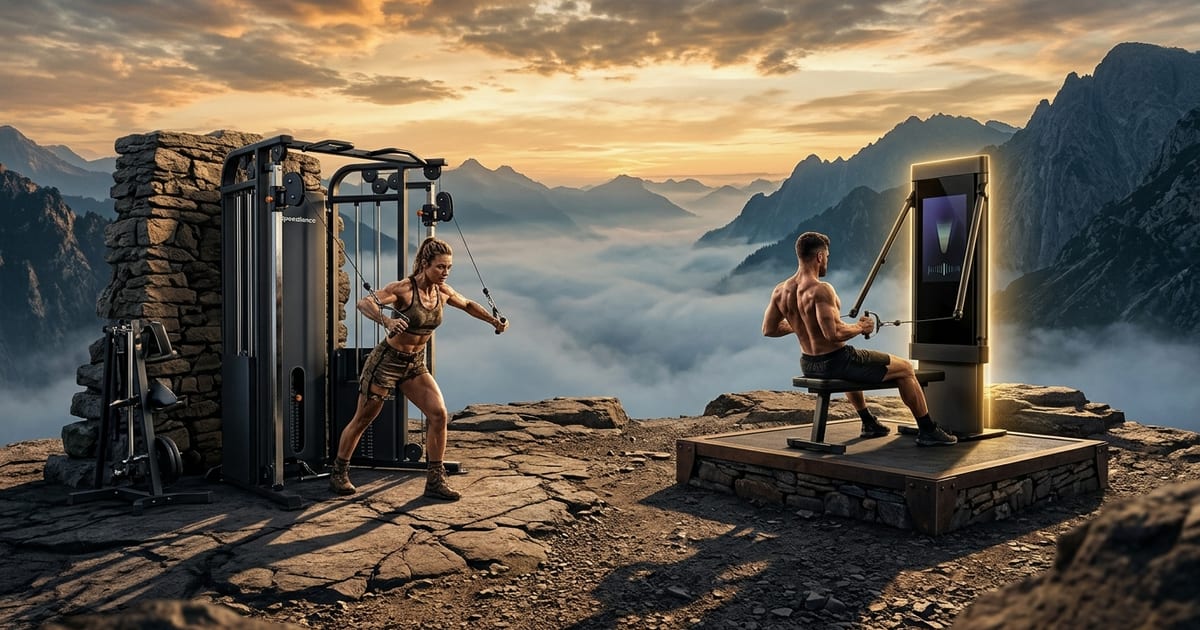
In the Speediance Gym Monster 2 vs Tonal 2 matchup, the Tonal 2 handles heavier lifting: it maxes out at 250 lbs of digital resistance (125 lbs per arm) versus 220 lbs (110 lbs per arm) on the Gym Monster 2. The Speediance costs less ($3,387 vs $4,295), has no mandatory subscription, and is freestanding instead of wall-mounted. For strength athletes whose squat and deadlift working sets already exceed about 220 to 250 lbs, neither machine replaces a barbell. Both work best as eccentric-loading and accessory tools alongside a rack.
TL;DR
Tonal 2 offers 250 lbs of max resistance and costs $4,295 plus a required 12-month membership at $59.95/month. The Speediance Gym Monster 2 offers 220 lbs for $3,387, folds to 2.69 sq ft, and does not need wall installation. Both include an eccentric mode that adds resistance on the lowering phase. That mode is the most useful feature either machine has for strength athletes. If you log sessions in Kenso or another tracker, you will enter machine sets manually. Neither machine syncs set-level data to third-party loggers.
The Numbers That Matter for Heavy Lifting
Marketing pages lead with total resistance. For compound lifts, the per-arm limit and how the load reaches the bar matter more.
Max Resistance: Tonal 2 vs Speediance Gym Monster 2
- Tonal 2: 250 lbs total, 125 lbs per arm
- Speediance Gym Monster 2: 220 lbs total, 110 lbs per arm
- Gap: 30 lbs total, 15 lbs per arm
When you attach a straight bar to both cables for a squat, deadlift, or bent-over row, you get the full total: 250 or 220 lbs. With handles on a single cable, such as a single-arm row or split squat, you are capped at 125 or 110 lbs.
Home Gym Advice points out that the gap is smaller in practice than the spec sheet suggests, unless you train near the top of the range. That is accurate for most users. Strength athletes, though, are exactly the people who train near the top of the range.
Why 250 lbs Is a Low Ceiling for Compound Lifts
A 250-lb ceiling sits below the working sets of many trained lifters on the deadlift, and often on the squat. If your deadlift top set is 365, a smart cable machine cannot load that pattern for you, no matter which brand you buy.
There are also mechanical differences between a cable and a barbell:
- Line of pull. The cables pull from fixed anchor points, so the resistance vector is not perfectly vertical the way gravity is on a barbell.
- No inertia. Digital resistance doesn't behave like a mass you have to accelerate and stabilize. Many lifters find heavy cable squats feel different from heavy barbell squats.
- Stability demand. A barbell punishes a bad bar path. A cable-attached bar is more forgiving, which suits accessory work but trains less of the skill component of a competition lift.
None of this makes either machine bad. It means the right question isn't which one replaces your barbell. The better question is which one adds the most to a barbell-based program.
Eccentric Loading: Where These Machines Earn Their Price
This is the argument for owning a smart cable gym as a strength athlete. Both machines can increase resistance during the lowering phase of a rep. Doing the same thing with a barbell requires weight releasers or a training partner.
How Each Machine Handles Eccentric Mode
- Speediance Gym Monster 2: Eccentric Mode is one of four resistance modes. According to Speediance's feature documentation, it isolates the negative phase and increases resistance as you return to the starting position. Standard Mode holds resistance constant at your selected weight.
- Tonal 2: It offers eccentric loading as one of several advanced resistance modes and pairs it with camera-based form feedback that Garage Gym Reviews highlights as a differentiator.
On both machines, eccentric mode lets you lower more than you lift. That is something gravity-based loading cannot do on its own.
What the Research Says About Eccentric Training
The evidence here is reasonably solid. A meta-analysis by Roig et al. (2009) in the British Journal of Sports Medicine found that eccentric training tended to produce greater strength gains than concentric training. Schoenfeld et al. (2017) in the Journal of Strength and Conditioning Research found eccentric and concentric actions both drive hypertrophy, with a modest trend favoring eccentric work.
Research on already-trained lifters is more limited, but promising. Walker et al. (2016) in Frontiers in Physiology reported greater strength gains in strength-trained men using accentuated eccentric loading compared with traditional loading. Research consistently suggests eccentric overload is a useful stimulus, but it is also more fatiguing and causes more soreness. Dose it carefully.
How to Program Eccentric Work on a Smart Cable Gym
This approach works on either machine and fits alongside a barbell program without competing with your main lifts.
- Pick one or two movements per session that live comfortably under the machine's ceiling. Good options include Romanian deadlifts, rows, split squats, and presses. Skip heavy squats and deadlifts here.
- Set the concentric load to a weight you could lift for roughly 8 to 10 reps in standard mode.
- Turn on eccentric mode and control each lowering phase for 3 to 4 seconds.
- Perform 3 to 4 sets of 4 to 6 reps, stopping 1 to 2 reps short of losing tempo.
- Progress by about 5 lbs when you complete every rep of every set with full tempo control.
- Start with one eccentric-emphasis session per week for 2 to 3 weeks before adding a second. The soreness from eccentric overload is real.
- Place this work after your barbell lifts, or on a separate day from heavy lower-body sessions.
Use the per-arm limits to your advantage. On unilateral movements like single-arm rows, single-leg RDLs, and split squats, 110 to 125 lbs per side is more than most lifters need. Unilateral work is also where cable machines are strongest.
How This Fits Into Your Training Log
Kenso's rule-based progression engine suggests your next load from logged weight and reps, so record the machine's concentric setting and note the eccentric mode on each set. Then log your eccentric cable sets in Kenso.
Ranked: Which Setup Fits a Strength Athlete?
1. Barbell and Rack Plus a Smart Cable Gym
Verdict: The strongest option for serious lifters. The barbell covers heavy compounds and the machine covers eccentric overload and accessories.
- Uncapped loading for squat, bench, and deadlift
- Eccentric mode for targeted overload work
- Requires the most space and budget
2. Tonal 2
Verdict: The better standalone choice if you want the highest ceiling and the most guided programming.
- 250 lbs max (125 lbs per arm)
- $4,295 plus a required 12-month membership at $59.95/month
- Wall-mounted, professional installation, camera-based coaching
3. Speediance Gym Monster 2
Verdict: The better value and the better fit for renters or flexible spaces, at the cost of 30 lbs of ceiling.
- 220 lbs max (110 lbs per arm), four resistance modes including eccentric
- $3,387 with no mandatory subscription
- Freestanding, about 172 lbs, folds to 2.69 sq ft
Comparison Table
| Machine | Max Resistance | Per Arm | Eccentric Mode | Installation | Price | Membership |
|---|---|---|---|---|---|---|
| Tonal 2 | 250 lbs | 125 lbs | Yes | Wall-mounted, professional install | $4,295 | Required: 12 months at $59.95/mo |
| Speediance Gym Monster 2 | 220 lbs | 110 lbs | Yes (one of four modes) | Freestanding, foldable | $3,387 | Not required |
Your first-year cost on the Tonal 2 is $4,295 plus $719.40 in membership fees, which comes to about $5,014 before tax. That is roughly $1,600 more than the Gym Monster 2 in year one.
Screen size is listed inconsistently across sources for the Gym Monster 2. Reviews report anywhere from 21.5 to 23.8 inches, so confirm on the current retailer listing. The Tonal 2 has a 24-inch HD touchscreen.
How to Choose Between Tonal 2 and Speediance
- Compare your heaviest working sets to the ceiling. If your squat and deadlift working sets are already above 220 to 250 lbs, keep a barbell for those lifts. Buy the machine for accessories and eccentrics, and the 30-lb gap matters less.
- Check your walls and your lease. Tonal 2 needs a suitable wall and professional installation. The Gym Monster 2 is freestanding and can move with you.
- Price out the full cost. Tonal's required membership adds over $700 in year one. Factor in whether you will use its classes or follow your own program.
- Decide how much you value form feedback. Tonal's camera-based coaching is a real advantage for lifters who train alone. Experienced lifters running their own programs may not need it.
- Plan how you'll log sessions. If you track your training in a dedicated logger like Kenso, expect to enter machine sets by hand. Workout-level data may reach Apple Health depending on the machine, but set and rep detail generally won't.
Final Verdict
For raw heavy lifting, the Tonal 2 wins on paper. Its 250-lb ceiling and 125-lb per-arm limit give you more room on bar-attachment compounds. The Speediance Gym Monster 2 is the more practical purchase for most lifters. It costs less, carries no forced subscription, and doesn't require drilling into a wall.
For strength athletes, neither should be your primary squat or deadlift tool once your numbers pass the low 200s. The best use of either machine is controlled, progressive eccentric overload and unilateral accessory work alongside a barbell. Buy the one that fits your space and budget, program it with intention, and track every session so the work compounds over months, not weeks.
If you're adding a smart cable gym to an existing program, Kenso can hold both your barbell and machine work in one log. Its AI Coach, powered by Claude, can review your training history to help you decide where eccentric sessions fit. Download Kenso on iOS to keep your progression in one place.
Frequently Asked Questions
Which is better for heavy lifting, Speediance Gym Monster 2 or Tonal 2?
Tonal 2 is better for heavy lifting, with 250 lbs of max resistance versus 220 lbs on the Speediance Gym Monster 2. For lifters whose working sets exceed those numbers, neither replaces a barbell for squats and deadlifts.
What is the Tonal 2 max weight?
The Tonal 2 provides up to 250 lbs of digital resistance, or 125 lbs per arm. With a bar attachment you can use the full 250 lbs. With a single handle you are limited to 125 lbs.
How does Speediance eccentric mode work?
Speediance's Eccentric Mode increases resistance during the lowering phase of a rep, so you lower more than you lift. It is one of four resistance modes on the Gym Monster 2, alongside Standard Mode, which holds resistance constant.
Does Tonal 2 require a subscription?
Yes. Tonal 2 requires a 12-month membership at $59.95 per month plus taxes, which adds about $719 to the first-year cost. The Speediance Gym Monster 2 does not require a subscription.
Can a smart cable gym replace a barbell for strength training?
For beginners and many intermediates, a smart cable gym can cover most training needs. Strength athletes with squat or deadlift working sets above 220 to 250 lbs will outgrow either machine's ceiling on those lifts. They are better served using the machine for eccentric and accessory work.
Can I track Speediance or Tonal workouts in Kenso?
Yes, by logging your sets manually in Kenso. Kenso's only external data source is Apple Health, and it does not connect directly to Speediance or Tonal hardware. Record the weight and reps from each set, and note when you used eccentric mode.
Sources
- Garage Gym Reviews, Expert Comparison: Speediance vs. Tonal (2026)
- Home Gym Advice, Tonal 2 vs Speediance Gym Monster 2: Which Wins
- Speediance, Gym Monster 2 Features: Smart AI Strength (resistance mode documentation)
- Discipline Dave (YouTube), Tonal 2 vs Speediance Gym Monster vs AEKE S1 Pro: I Own All 3 (November 2026)
- Roig M, et al. The effects of eccentric versus concentric resistance training on muscle strength and mass in healthy adults: a systematic review with meta-analysis. British Journal of Sports Medicine, 2009.
- Schoenfeld BJ, et al. Hypertrophic effects of concentric vs. eccentric muscle actions: a systematic review and meta-analysis. Journal of Strength and Conditioning Research, 2017.
- Walker S, et al. Greater strength gains after training with accentuated eccentric than traditional isoinertial loads in already strength-trained men. Frontiers in Physiology, 2016.
This article contains affiliate links. We may earn a small commission at no extra cost to you.