
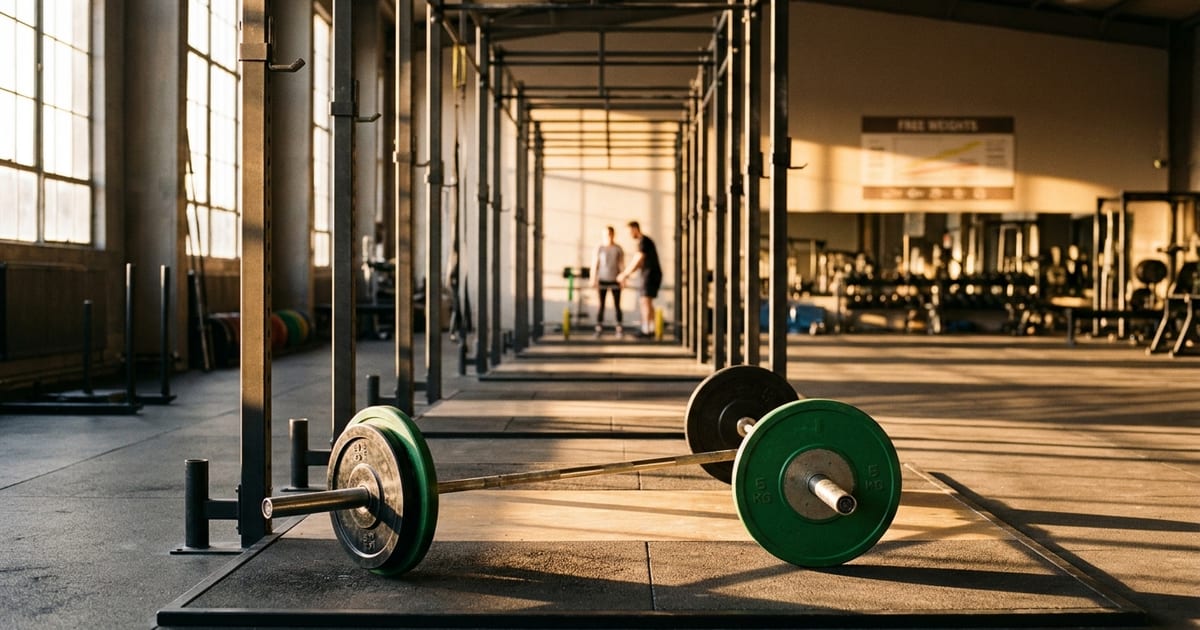
There is no single "normal" strength level for your first week in the gym. Your starting weights depend on your bodyweight, sex, age and athletic background. For context, Strength Level's crowdsourced data puts a "Beginner" one-rep max bench press at around 47 kg for men and 17 kg for women. "Beginner" there means roughly the 5th percentile of people who log lifts on the site. It does not describe a typical first-week lifter, and it isn't a target. Your first week has one job: find weights you can move with clean technique for 8 to 12 reps, then write them down as your baseline.
Week-One Protocol at a Glance
| Item | Week-one target |
|---|---|
| Sessions | 2–3 full-body sessions |
| Movements | One squat, one hinge, one push, one pull |
| Ramp-up sets | 3–5 reps per jump (not full sets) |
| Working sets | 2–3 sets at your final weight |
| Reps per working set | 8–12 |
| Effort | About 2 reps in reserve (RPE ~8), with unchanged form |
What Beginner Strength Standards Actually Show
Strength Level builds its standards from lifts submitted by its users. Its general standards for an estimated one-rep max at the "Beginner" level are:
| Lift | Men (1RM) | Women (1RM) | Source |
|---|---|---|---|
| Bench press | 47 kg | 17 kg | Strength Level |
| Deadlift | 78 kg | 38 kg | Strength Level |
| Shoulder press | 30 kg | 13 kg | Strength Level |
General (not bodyweight-adjusted) Beginner standards from Strength Level. Figures may change as the site's dataset grows, so check the live page for current values.
What "Beginner" means here: Strength Level ranks lifters by percentile. "Beginner" marks a low percentile, roughly the 5th percentile of the lifters in its dataset. That dataset is made up of people who already train and chose to log their lifts. So "Beginner" is not "what someone lifts in their first week," and it is not a goal to hit straight away.
Two more caveats matter. First, these are one-rep max figures, and you won't be testing maxes in week one. Second, they come from a self-selected group of people who log their lifts. That makes them a useful reference, not a requirement. If you're below them, you aren't behind. You've found your starting point.
Why Week One Is a Calibration Week
Early strength increases come mostly from your nervous system learning the movement, not from new muscle. In an 8-week training study, Moritani and deVries (1979, American Journal of Physical Medicine 58(3):115–130) found that neural factors accounted for most of the strength increase in the early weeks, with hypertrophy contributing more in the later weeks. Sale's review (1988, Medicine & Science in Sports & Exercise 20[5 Suppl]:S135–145) reached the same conclusion: early improvement comes largely from better coordination and muscle activation.
Measurable muscle growth takes longer. Damas et al. (2016, Journal of Physiology 594(18):5209–5222) found that early increases in muscle cross-sectional area, around week 3, were largely explained by swelling (edema) from training-induced muscle damage. True hypertrophy only became measurable later, around week 10, once the damage had subsided.
The practical takeaway: your week-one numbers will rise quickly almost no matter where they start. Starting too heavy only slows down the learning that drives that early progress.
How to Find Your Starting Weights
Use two or three full-body sessions this week. Cover a squat, a hinge, a push and a pull.
- Start with an empty bar or light dumbbells for one warm-up set of 10. Bars vary. A standard Olympic bar weighs 20 kg, women's bars are often 15 kg, and many gyms also have technique or fixed bars between 5 and 15 kg. Ask staff, or check the bar's markings, so you log the right starting weight.
- Ramp up in small jumps, such as 5 kg on barbell lifts or 2 kg per dumbbell. Keep these ramp-up sets short, at 3 to 5 reps each. Full 8–12 rep sets at every jump build fatigue and drag down your working-set numbers.
- Pick your working weight. When a ramp-up weight starts to feel moderately heavy, try the next jump for a full set. Stop adding weight when you finish 8 to 12 reps with about 2 reps in reserve (RPE ~8) and unchanged form.
- Do 2 to 3 working sets at that weight. Only this final weight gets full 8–12 rep sets.
- Record the weight, reps, sets and RPE for every exercise.
If your form breaks down before you reach 8 reps, the weight is too heavy. Drop back to the previous jump.
Starting on machines or dumbbells instead of a barbell
The same ramp-up logic applies without a barbell, with two adjustments:
- Machines: Start on the lightest or second-lightest plate of the stack and ramp up one or two plates at a time. Stack numbers aren't standardized between brands, so 40 kg on one chest press won't feel like 40 kg on another. Log the machine (and seat or pin settings) alongside the weight so your baseline stays comparable.
- Dumbbells: Fixed dumbbells usually jump in 1–2.5 kg steps per hand, which can be a large relative increase at light weights. If the next pair is too heavy for 8 reps, stay at the current weight and add reps until you reach the top of the 8–12 range before moving up.
Why "2 reps in reserve" is harder than it sounds
Judging reps in reserve is a skill. New lifters often find it hard to tell how close they are to failure, and they tend to underestimate how many reps they actually have left. A set that feels like RPE 8 in week one may have more left in it. That's fine for calibration: it errs on the safe side while you learn the movement. Your judgment will sharpen with practice, which is another reason to log RPE on every set from day one.
A Worked Example: Week One vs. Week Four
The numbers below are illustrative only. They are not data from real users and not a prediction for you.
Take a hypothetical new lifter using a 20 kg bar on the bench press:
| Week 1 | Week 4 | |
|---|---|---|
| Ramp-up | 20 kg × 10, 25 kg × 5, 27.5 kg × 4 | 20 kg × 10, 30 kg × 5, 35 kg × 3 |
| Working sets | 30 kg × 10, 10, 9 | 37.5 kg × 10, 9, 9 |
| RPE on last set | ~8 | ~8 |
| Estimated 1RM (Epley, first 10-rep set) | ~40 kg | ~50 kg |
Both estimates use the first working set of 10 reps: 30 × (1 + 10 ÷ 30) = 40 kg in week 1, and 37.5 × (1 + 10 ÷ 30) = 50 kg in week 4. Because these sets stopped at about 2 reps in reserve, both figures are conservative (see the caveat below). Adding the 2 reps in reserve to the rep count gives about 42 kg and 52.5 kg.
The point isn't the specific numbers. It's that logging the same effort level (about 2 reps in reserve) each week lets you see real progress instead of guessing.
How to estimate your one-rep max later
You never need to test a true max to compare yourself with the standards table. The Epley formula estimates it from a rep set:
e1RM = weight × (1 + reps ÷ 30)
For example, 50 kg for 8 reps gives 50 × (1 + 8 ÷ 30) ≈ 63 kg. Estimates are most reliable from sets of roughly 10 reps or fewer, so treat them as a rough guide.
Caveat: The formula assumes the set was taken to or near failure. Sets logged at RPE ~8 (about 2 reps in reserve) will underestimate your e1RM. You can add your reps in reserve to the rep count (8 reps at RPE 8 becomes 10 in the formula), or simply treat the result as a conservative figure. Once you've trained consistently for three to six months, use your best logged sets to estimate e1RMs and compare them with the table above.
How This Fits Into Your Training Log
Kenso, an iOS-only workout logger, is built for exactly this kind of baseline:
- RPE per set. You can log RPE on each set, which maps directly onto the "about 2 reps in reserve" rule. RPE ~8 means roughly two reps left.
- Rest timer. It keeps the rest between working sets consistent, so week-to-week numbers are comparable.
- Rule-based progression engine. It uses your logged sets to suggest your next weight or rep target, and it flags when a deload may be due.
Calibrate carefully this week, then log your week-one baseline sets in Kenso (iPhone only) so every future session builds from real numbers.
Returning after a break? You don't have to start your log from zero. Settings → Import Workouts accepts Strong or Hevy CSV exports for free. Your previous sessions then count toward your PRs, charts and muscle coverage. If you import 6 or more sessions from the last 3 months, Kenso also shows a free post-import diagnosis: muscle balance (where your volume went and which muscles got too little) and strength standing (your best e1RM per anchor lift, tiered against standards when your sex, bodyweight and age are known). That gives you a standards comparison based on your own history rather than a guess.
The Number That Matters Is Your Second Week
Comparing yourself to a population chart tells you little. Comparing week two to week one tells you a lot. Many novice programs add small increments each session or week while reps stay in the target range: 2.5–5 kg on lower-body lifts and 1–2.5 kg on upper-body lifts. That's common program practice, not a guaranteed rate. If you track from the first session, you'll see whether that trend is happening for you.
With Kenso Pro ($5.99/month or $49.99/year, available in the App Store or on kensoforge.com; code EARLY gives one month free), you also get the AI Coach. It's a chat assistant that reads your logged training history, helps you work out why a lift has stalled, and can adjust your program when you ask.
Strength standards are worth revisiting after three to six months of steady training. By then, comparing your estimated maxes to the chart will tell you something useful about your progress.
Conclusion
Normal first-week strength is whatever you can lift well for 8 to 12 reps with about 2 reps in reserve. Use published standards as context, not a verdict. Start lighter than your ego suggests, keep ramp-up sets short, record every set, and let consistency do the work. Download Kenso (iOS only) to turn your first week into the baseline for months of measurable progress.
FAQ
How much should a beginner lift in the first week?
Lift a weight you can move for 8 to 12 reps with about 2 reps in reserve (RPE ~8) and unchanged form. For many people that starts with an empty bar or light dumbbells. Bars range from about 5 kg to 20 kg, so check which one you're using. The right number is individual, not a fixed standard.
Is it bad if I can't lift the empty barbell?
No. A standard Olympic bar weighs 20 kg, which is a lot for some new lifters. Use dumbbells, a 15 kg women's bar, a lighter technique or fixed bar (often 5–15 kg), or machines until the movement feels stable. Many new lifters progress to the full barbell within a few weeks.
How fast will my strength increase as a beginner?
New lifters usually improve quickly at first, largely through neural adaptation such as better coordination and muscle activation (Moritani & deVries, 1979; Sale, 1988). Measurable muscle growth takes longer; early size increases are partly swelling from muscle damage (Damas et al., 2016). In practice, many novice programs add 2.5–5 kg on lower-body lifts and 1–2.5 kg on upper-body lifts per session or week, as long as you stay in your rep range and keep about 2 reps in reserve.
Should I test my one-rep max in my first week?
No. Max testing needs stable technique, which takes weeks to develop. You can estimate a max later from your logged rep sets with the Epley formula: weight × (1 + reps ÷ 30). Sets stopped short of failure give a conservative estimate, so add your reps in reserve to the rep count or treat the result as a lower bound.
When should I compare myself to strength standards?
After three to six months of consistent training. By then your numbers reflect actual strength rather than how quickly you learned the movements. Remember that Strength Level's "Beginner" level marks a low percentile of people who already log lifts. It is not a first-week target.